
Howdy Readers 🥰
In this newsletter, you’ll find:
🚪 Optimizing the page doesn’t matter if your domain never made the list
📊 Costs spiked on YouTube and Pinterest, and returns didn’t come close to justifying it
🏆 Ad of the day
If you’re new to ScaleUP then a hearty welcome to you. You’ve reached the right place along with 50k+ CEOs, CMOS, and marketers. Let’s get into it, shall we? Oh! Before you forget, if someone forwarded this newsletter to you, don't forget to subscribe to our newsletter so you never miss out!
🚪 Optimizing the page doesn’t matter if your domain never made the list
AI search retrieval is shifting in a specific direction worth naming: instead of ranking every page on the open web for a query and citing whichever ones score highest, retrieval increasingly starts from a shortlist of domains the system already trusts for a category, then answers from within that list.
A page can be perfectly optimized and still never get evaluated if the domain hosting it was never on the shortlist to begin with.
That’s a different failure mode than a ranking problem, and it needs a different fix. Content-level optimization, better structure, clearer answers, stronger schema, does real work once a domain is inside the trusted set for its category.
It does close to nothing if the domain isn’t in that set, since the content never gets far enough into retrieval to be judged on its merits.
Test whether your domain is being pulled from at all before optimizing pages
Before spending another cycle on page-level AI optimization, run a direct test: ask the AI systems your customers use the core comparison questions in your category, and check not just whether your brand is mentioned, but whether your domain specifically shows up anywhere in the sourcing, even indirectly through a citation of a page on your site.
A domain that never appears, even for well-optimized pages, is signaling a category-eligibility problem, not a content-quality one, and that distinction changes where the next quarter of effort should go. Confirming which read applies is exactly what Semrush’s AI Visibility Toolkit is built to test across ChatGPT, Perplexity, Gemini, and Google AI Mode.
Build category authority before betting further on page optimization
Getting added to a trusted category shortlist isn’t primarily a content exercise. It’s an authority exercise, built through independent corroboration and consistent presence across review platforms, press, and community discussion, signaling to a retrieval system that your domain belongs in the category’s trusted set.
Prioritize that groundwork over further page-level polish if the eligibility test above comes back negative. A perfectly optimized page on a domain outside the trusted shortlist is optimization spent on a step that never gets reached.
Monitor category eligibility as its own metric, not folded into general visibility tracking
Whether a domain is inside a category’s trusted shortlist can change over time as new competitors build authority and as retrieval systems update how they define trust for a given category, which means this isn’t a one-time check.
A page can be excellent and still invisible. The question worth answering first is whether the domain underneath it ever got a seat at the table. You can try it free for 7 days.
📊 Costs spiked on YouTube and Pinterest, and returns didn’t come close to justifying it
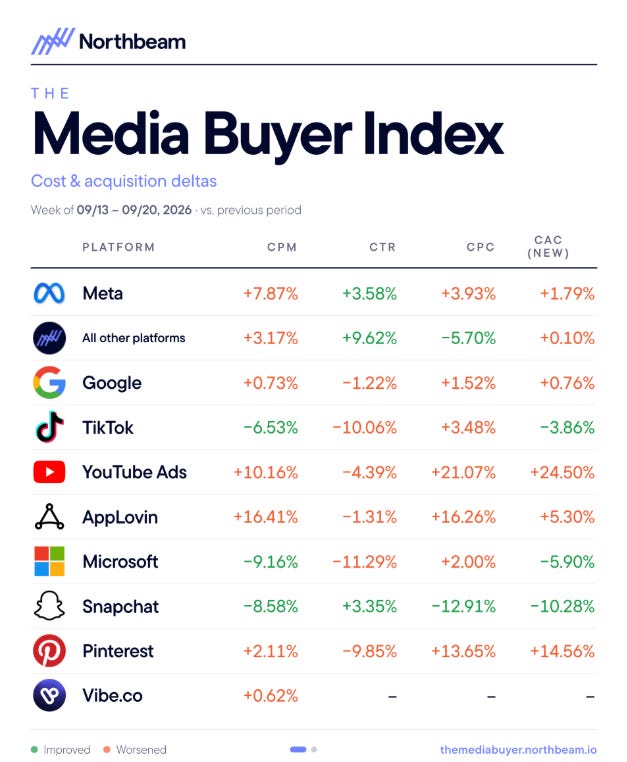
Last week brought one of the sharper cost divergences of the quarter, impressions and click costs climbed steeply on several platforms heading into the final stretch of September, while returns fragmented in ways that make Q4 budget positioning more consequential than usual right now.
The Breakdown:
CPC - TikTok and Snapchat saw click costs fall while YouTube, Pinterest, and Meta pushed higher, where CPCs spiked alongside deteriorating ROAS, reducing spend now rather than holding through pre-Q4 auction inflation.
CAC - TikTok, Microsoft, and Snapchat improved while YouTube, Pinterest, and Meta worsened; YouTube’s CAC spike alongside -14.72% ROAS makes it the week’s clearest pause candidate; freeze budget there until both metrics stabilize.
ROAS - Snapchat led at +8.12%, and Microsoft posted +1.58% while YouTube (-14.72%) and Pinterest (-7.51%) collapsed; rotate active spend into Snapchat and Microsoft now, and treat both laggards as a two-week trend, not a one-week blip.
Meta holds 54.35% of spend with -3.52% ROAS despite improving CAC, the gains aren’t reaching the return line, so hold Meta flat rather than scaling into an unconfirmed signal. YouTube at 3.20% posted -14.72% ROAS and +24.50% CAC in the same week.
Cut YouTube and Pinterest exposure now, redirect into Snapchat where ROAS and share are both moving up, and set hard CAC ceilings before any Q4 budget increases go live.
🏆 Ad of the Day
What Works:
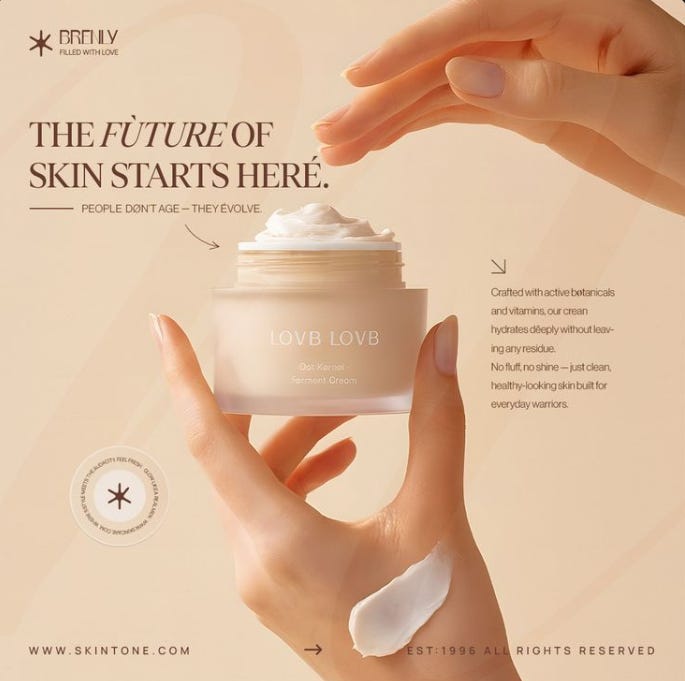
Future Frames Desire - “The future of skin starts here” gives the product an aspirational, forward-looking hook, making everyday moisturizer feel more transformative while keeping the promise emotionally premium.
Texture Builds Sensation - The visible cream on the jar and hand adds tactile product communication, helping shoppers imagine richness and hydration while making the formula feel more tangible.
Minimalism Signals Premium - The warm neutral palette, soft lighting, and generous negative space create a refined visual hierarchy, lowering cognitive load while strengthening perceived quality and branding recall.
For skincare, show the formula outside the packaging on skin, fingers, or surfaces. That turns an invisible product benefit into a sensory cue shoppers can immediately understand.
🥳 Events
🔥 What 380,000 AI Answers Reveal About Getting Into the Buyer’s Shortlist
September 29 | 1 PM ET | Virtual Event
Ross Simmonds and Josh Spilker unpack 3 million citation events across 81 software topics to show where AI gets its recommendations. Learn which prompts matter, which external sources shape consideration, and where your brand needs stronger coverage before the buyer ever reaches your site.
Can’t attend the session live? Register anyway, and you’ll get the recordings in 24 hours.
🔥 What Changes When Creator Programs Scale From 5 to 5,000
October 21 | Online | Free Festival
Return on Influence Festival ’26 opens up the systems behind large creator programs, including how teams track ROI, improve partnerships, and avoid operational chaos as volume grows. Hear directly from leaders at Adobe, ŌURA, Edelman, Ogilvy, and more.
Can’t attend every session live? Register anyway, and you’ll get the recordings in 24 hours.
Advertise with Us
Wanna put out your message in front of over 50,000 best marketers and decision makers?
We are concerned about everything DTC and its winning strategies. If you liked what you read, why not join the 50k+ marketers from 13k+ DTC brands who have already subscribed? Just follow this.
At ScaleUP, we care about our readers and want to provide the best possible experience. That's why we always look for ways to improve our content and connect with our audience. If you'd like to stay in touch, be sure to follow us EVERYWHERE🥰
Thanks for your support :) We'll be back again with more such content 🥳