
Howdy Readers 🥰
In this newsletter, you’ll find:
👎 Your hook isn’t the problem. Your middle is.
📊 Costs Are Rising Broadly, But Conversion Quality Is Separating the Platforms Worth Holding
🏆 Ad of the Day
If you’re new to ScaleUP then a hearty welcome to you. You’ve reached the right place along with 50k+ CEOs, CMOS, and marketers. Let’s get into it, shall we? Oh! Before you forget, if someone forwarded this newsletter to you, don't forget to subscribe to our newsletter so you never miss out!
👎 Your hook isn’t the problem. Your middle is.
Everyone’s optimizing the wrong 10 words.
Hooks get obsessed over. The body gets winged. And the gap between a post that converts and one that flatlines almost never lives in the opener, it lives in the 150 words nobody thought hard about.
Why the middle keeps failing
The body isn’t just filler between hook and CTA. It’s where trust is built or lost. But most writers treat it like a hallway, something to get through, not somewhere to take people.
The result: content that gets opened, skimmed, and forgotten. Not because the hook was weak. Because nothing after it had a reason to exist.
Here’s what strong body copy actually does:
It inherits the tension from the hook and keeps pulling it
It moves, each point creates a small question the next one answers
It makes the CTA feel like a conclusion, not an interruption
The tips nobody talks about
1. Write the middle before the hook. Most writers hook first, fill later. Flip it. Write the body when the thinking is sharpest, then write a hook that makes that specific body unavoidable to read. You stop writing generic openers for specific content.
2. Give every paragraph one job. Introduce tension. Build it. Release it. If a paragraph isn’t doing one of those three things, it’s decoration. Cut it or reassign it.
3. Use the “so what” test per point. After each point, ask: so what does this mean for the reader right now? If you can’t answer in one sentence, the point isn’t ready. This forces specificity and kills the vague insight problem most educational content suffers from.
4. Manufacture micro-tension. The best body copy doesn’t resolve everything at once. It opens a small loop, closes it, opens another.
Readers don’t leave mid-paragraph when they’re waiting for a resolution. This isn’t a trick, it’s how good storytelling works at the sentence level.
5. Match the body’s energy to the hook’s promise. If your hook is provocative, the body needs to deliver something that justifies the provocation, not soften it with caveats.
If your hook is data-led, the body needs specifics, not vibes. Mismatch between hook energy and body energy is why readers feel misled even when nothing was technically false.
What to do with this
Next time you finish a draft, ignore the hook entirely on your first reread. Read only from the second paragraph down. Ask three questions:
Does each point move the reader somewhere new?
Can any section be skipped without losing the thread?
Does the CTA feel like it was earned by what came before?
If the answer to question two is yes anywhere, that’s your edit. The hook was never the issue. The middle just needed to do its job.
📊 Costs Are Rising Broadly, But Conversion Quality Is Separating the Platforms Worth Holding
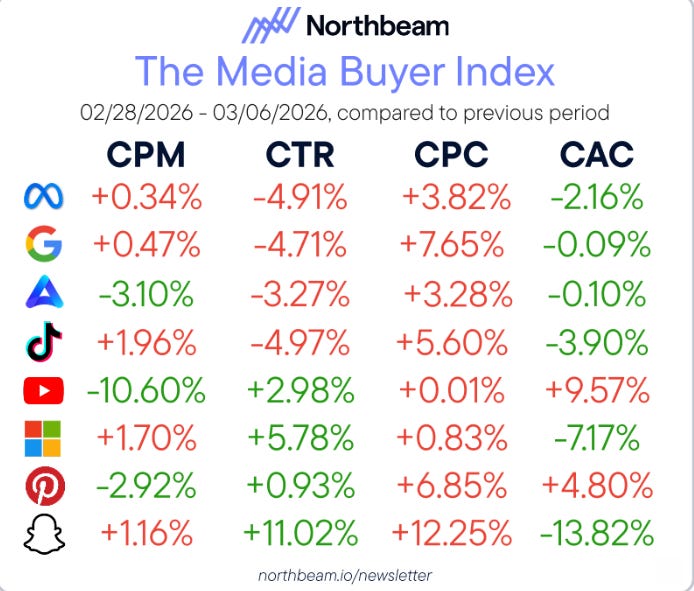
Intro Last week’s paid media environment showed widespread cost increases across most major platforms, while conversion efficiency fractured sharply, creating a market where spend discipline matters more than channel loyalty.
The Breakdown:
1. CPC - Google and Snapchat led cost increases while YouTube held nearly flat, rising CPCs across Meta, TikTok, and Pinterest with simultaneous CTR declines, meaning teams are paying more to reach audiences who are clicking less, a compounding efficiency problem.
2. CAC - Snapchat, Microsoft, and TikTok all improved acquisition costs despite the broader CPC pressure. When CAC falls while CPC rises, it signals creative or audience matching is doing real work, and those channels deserve closer budget attention, not assumption.
3. ROAS - Pinterest surged to +26.34%, and Microsoft posted +16.66% while YouTube (-3.57%), AppLovin (-3.52%), and Meta (-2.86%) all slipped. Strong ROAS on low-share channels with rising budget share is a compounding signal that current allocation is lagging performance reality.
Meta held 64.90% of spend but shed share, while Google grew to 25.61% and YouTube gained +3.82% share despite negative ROAS. Pinterest at 0.61% and Microsoft at 0.96% are producing outsized returns relative to what they’re being given, which is an allocation problem hiding in plain sight.
🏆 Ad of the Day
What Works:
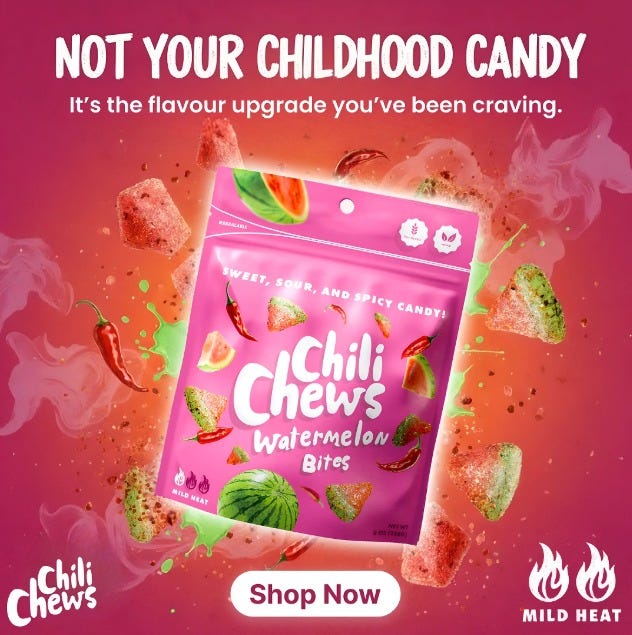
The Headline Is a Generational Disqualification - “Not Your Childhood Candy” isn’t a product claim, it’s an age signal. It tells you this was made for your adult palate, not nostalgia. It simultaneously distances itself from the category’s sugary-kid associations while flattering the buyer’s evolved taste.
“Flavour Upgrade You’ve Been Craving” Plants a False Memory - That subhead is sneaky. “Been craving” implies a pre-existing desire the customer didn’t know they had. It doesn’t say “you might like this,” it says your body already wants it and you just haven’t found it yet.
“Mild Heat” Is the Objection Handler in the Corner - Spicy candy loses buyers who want flavor but fear pain. Tucking “Mild Heat” with flame icons, bottom right, quietly removes the barrier without making it the headline. It’s there for the hesitant buyer scanning for permission.
Reframe your category’s biggest association as the thing your product graduates people from. “Not your [familiar thing]” positions you as the evolved version of something they already love, which is far easier than convincing someone to try something entirely new.
Advertise with Us
Wanna put out your message in front of over 50,000 best marketers and decision makers?
We are concerned about everything DTC and its winning strategies. If you liked what you read, why not join the 50k+ marketers from 13k+ DTC brands who have already subscribed? Just follow this.
At ScaleUP, we care about our readers and want to provide the best possible experience. That's why we always look for ways to improve our content and connect with our audience. If you'd like to stay in touch, be sure to follow us EVERYWHERE🥰
Thanks for your support :) We'll be back again with more such content 🥳