
Howdy Readers 🥰
In this newsletter, you’ll find:
🫠 Why the UGC Volume still fails
📊 Costs Fell Hard Across the Board — But Conversion Rates Fell Even Harder
🏆 Ad of the Day
If you’re new to ScaleUP then a hearty welcome to you. You’ve reached the right place along with 50k+ CEOs, CMOS, and marketers. Let’s get into it, shall we? Oh! Before you forget, if someone forwarded this newsletter to you, don't forget to subscribe to our newsletter so you never miss out!
🫠 Why the UGC Volume still fails
Getting ten creators running simultaneously means the brief has to do work it was never designed to do.
One person reads creative latitude one way, the next reads it entirely differently, and by the time you’re running ten in parallel, you have ten interpretations of the same strategy rather than ten executions of it. That gap, at scale, becomes the production budget.
1. Build the Identification Signals Before Sourcing Anyone
Aspirational and relatable are not the same thing, and most briefing processes cannot tell them apart before production.
The reliable check is three signals evaluated together before any creator gets greenlit:
how closely does the creator’s own caption language mirror what their audience writes in comments?
Do commenters describe themselves or describe the creator?
And is the creator’s visible life circumstance close enough to your customer’s that the viewer’s first instinct is recognition rather than admiration?
A creator whose comments read “this is literally my life” is an identification match. One whose comments read “you make it look so easy” is not, regardless of niche overlap.
2. Write the Brief as a Production Spec, Not a Creative Direction
A brief built for one creator breaks at ten. The interpretation gap compounds with each new creator added because every person reads creative latitude differently.
The fix is to shift brief language from directional to constrained: instead of “show how this fits your routine,” write the specific scene, the exact sentence structure the hook should follow, and the phrases that are off limits.
The creator brings authenticity to a defined frame rather than reinterpreting the frame entirely. Output consistency at scale follows from brief precision, not creator management.
3. Solve the Operations Ceiling Before It Caps the Strategy
When the brief is tight, and the profile is validated, the ceiling becomes operational: how fast can you source, vet, contract, and brief the next ten creators without brief quality degrading across the batch?
This is the exact stage Insense is designed for. Access to 80,000+ vetted creators, parallel campaign management, automated contracts and payments through Shopify integration, and content delivered in 14 days with full usage rights means the brief stays the only variable that matters.
When sourcing and contracting stop being the bottleneck, the strategy finally gets a fair test. You can book a free strategy call and get $200 in platform credit toward your first campaign.
📊 Costs Fell Hard Across the Board — But Conversion Rates Fell Even Harder
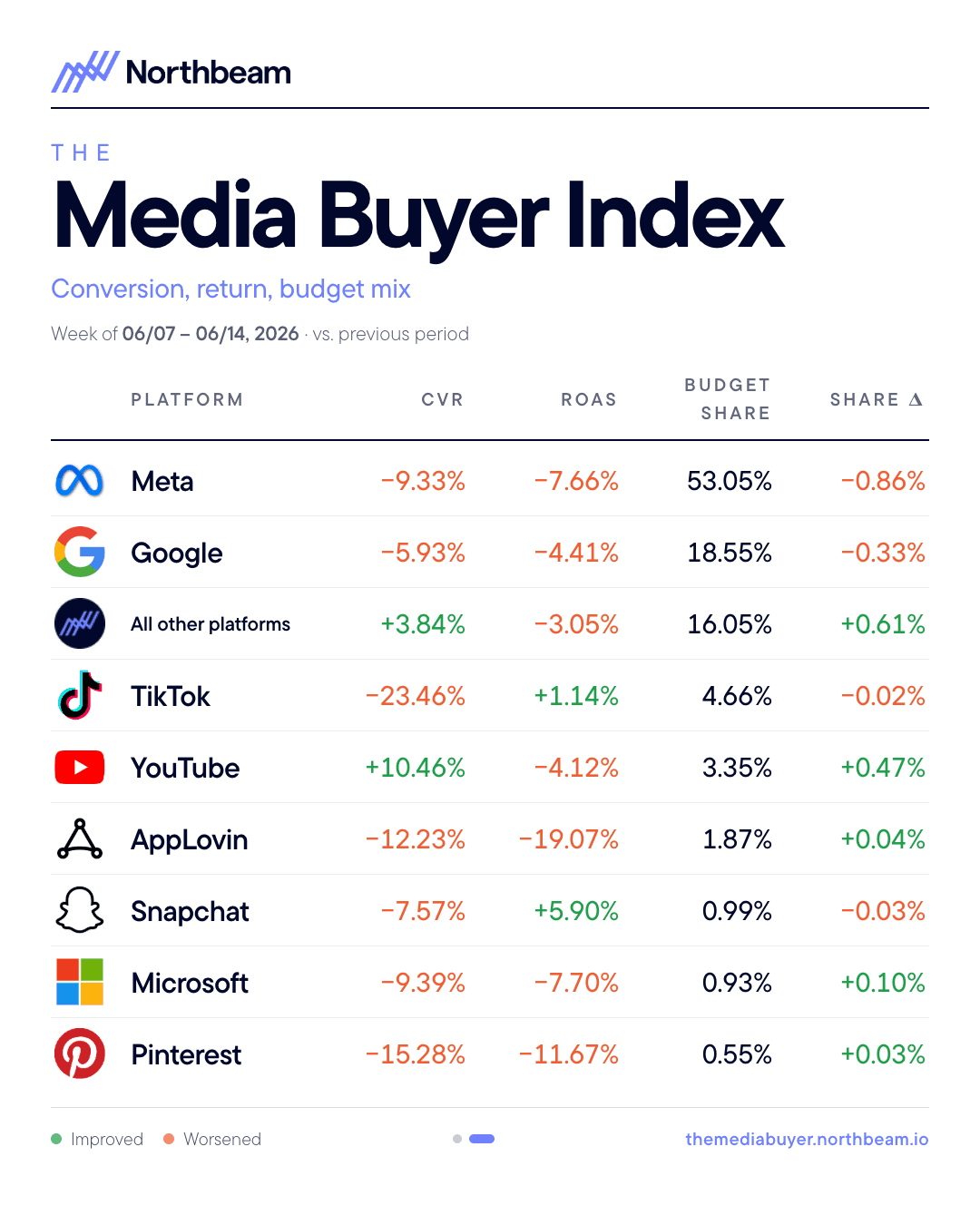
Last week delivered broad cost relief across nearly every platform, but the efficiency story inverted the moment you looked past the click: conversion rates and returns deteriorated sharply, turning what looked like a favorable week into a margin risk.
The Breakdown:
CPC - Google, Meta, TikTok, Snapchat, and Pinterest all saw click costs fall while AppLovin pushed higher, where CPCs dropped but CvR collapsed, hold budgets flat and run fresh creative before treating cheaper clicks as usable inventory.
CAC - YouTube, Google, and Snapchat improved while Meta, AppLovin, Microsoft, and Pinterest worsened, where CAC deteriorated despite falling CPCs; audit landing page speed, offer clarity, and checkout friction before making any bid adjustments.
ROAS - TikTok posted +1.14%, and Snapchat held at +5.90% while AppLovin collapsed at -19.07% and Pinterest dropped -11.67%; pause incremental spend on both laggards immediately and redirect into Snapchat where ROAS remains positive.
Meta holds 53.05% of spend with -7.66% ROAS and -9.33% CvR; the largest channel on the board is in a simultaneous cost and conversion decline, which at that share level becomes a portfolio-level problem, not a campaign one.
You can reduce Meta’s budget by 10–15% this week, redirect into YouTube where CAC improved and CvR gained +10.46%, and freeze AppLovin entirely until ROAS finds a floor.
🏆 Ad of the Day

What Works:
Personalization Premium - “Custom Serum” instantly increases perceived value. Consumers naturally assume something made for them should outperform something made for everyone.
Statistical Authority - The 82% figure creates credibility through specificity. Precise numbers feel researched, while vague claims feel like marketing.
Identity Ownership - The personalized label (”For Nell”) transforms the product from inventory into a possession. Ownership psychology starts before purchase.
If your product can be customized in any meaningful way, make the customization the hero rather than the formula. Personalization shifts the buying conversation from “Is this product good?” to “Could this be better for me?” which is a far easier question to win.
Advertise with Us
Wanna put out your message in front of over 50,000 best marketers and decision makers?
We are concerned about everything DTC and its winning strategies. If you liked what you read, why not join the 50k+ marketers from 13k+ DTC brands who have already subscribed? Just follow this.
At ScaleUP, we care about our readers and want to provide the best possible experience. That's why we always look for ways to improve our content and connect with our audience. If you'd like to stay in touch, be sure to follow us EVERYWHERE🥰
Thanks for your support :) We'll be back again with more such content 🥳