
Howdy Readers 🥰

In this newsletter, you’ll find:
🧠Utility Beats Authority In Search
📉 Efficiency improved, but spending stayed conservative
🏆 Ad of the Day
If you’re new to ScaleUP then a hearty welcome to you, you’ve reached the right place along with 50k+ CEOs, CMOS, and marketers. Let’s get into it, shall we? Oh! Before you forget, if someone forwarded this newsletter to you, don't forget to subscribe to our newsletter so you never miss out!
🧠Utility Beats Authority In Search
You write a page that answers a real question. It’s structured, well-written, and full of examples. You’d confidently hand it to a customer.
Then you ask ChatGPT or Perplexity the exact same question, and your content doesn’t show up. No citation. No paraphrase. Nothing.
That’s not a visibility bug. It’s a Utility Gap.
The Utility Gap, Defined
The Utility Gap is the space between what humans consider high-quality content and what AI systems find useful for producing an answer.
Humans scroll, skim, and tolerate warm-up. They infer meaning. Models don’t.
AI platforms work by retrieving content in chunks, then extracting specific signals to complete a task. They don’t need your story. They need the extractable parts: clear definitions, decisions, and constraints. If your key point is buried mid-page or framed poetically, it may be ignored entirely.
So yes, your content can be right, but still invisible.
The Extractability Problem
Recent research, like “Lost in the Middle,” shows that even long-context LLMs struggle to use information placed in the middle of inputs. They often prioritize content near the top or bottom.
That’s why positioning matters. If your most critical insight sits halfway down the page, it might as well not exist.
The solution is to structure for systems, not just people.
This is also where having visibility into what queries are driving AI discovery and which pages are actually being surfaced matters, and *Semrush One helps you connect search demand with content structure gaps before your best pages become non-citable. You can start your 7-day free trial now!
How to Make Content Model-Usable
Front-load the answer: Put the key definition, outcome, or default recommendation within the first 10–15% of the content. Save nuance and edge cases for later.
Write anchorable statements: LLMs pull from clean, declarative lines. Make your core guidance explicit, scannable, and stand-alone, like a quote that’s easy to lift.
In AI discovery, clarity and structure are performance levers. You’re no longer writing just for people. You’re writing for systems that decide what people see.
The Utility Gap isn’t a writing problem. It’s a visibility problem caused by assuming human relevance is enough. The brands that close it will win by design, not just by words.
📉 Efficiency improved, but spend stayed conservative
Paid media cooled slightly this week, with pockets of cheaper traffic and better conversion flow. Some channels saw real relief on acquisition costs, while others still struggled to turn spend into return. The focus now is clean scaling, not broad expansion.
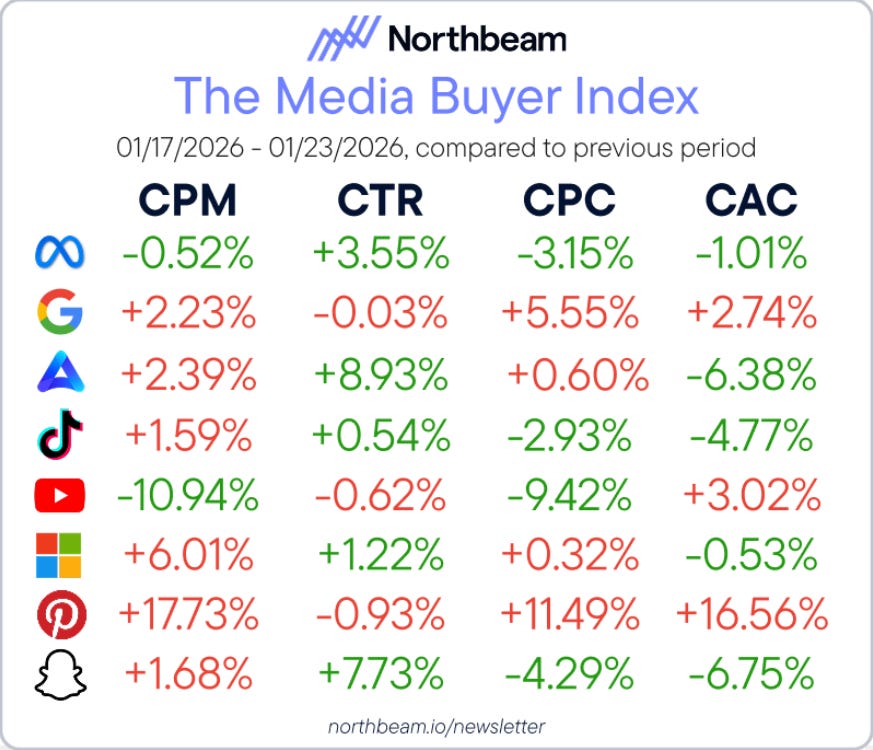
The Breakdown:
1. CPC - Costs rose on Google, Amazon, Microsoft, and Pinterest. Costs fell on Meta, TikTok, YouTube, and Snapchat. Lower-cost channels open room for fresh creative testing, while rising-cost channels demand tighter controls on waste.
2. CAC - CAC rose on Google, YouTube, and Pinterest. CAC fell on Meta, Amazon, TikTok, Microsoft, and Snapchat. Falling CAC signals stronger downstream efficiency, while rising CAC channels need sharper offer alignment before adding spend.
3. ROAS - Amazon led with +7.59% ROAS, with Google up +1.82%. Meta, TikTok, YouTube, Microsoft, Pinterest, and Snapchat all declined, with YouTube down -10.01%. Return strength is narrowing, so scale should stay focused on the few improving pockets.
Spend remained concentrated, with the largest channel holding 64.38% budget share and the next channel at 26.51%. Budgets pulled back from several smaller platforms while consolidating into steadier performers. Keep shifts incremental, and only re-accelerate where ROAS holds.
🏆 Ad of the Day

What Works:
The Line That Does All the Work - “Your body adapts before it warns you” is a low-key fear punch. It makes you feel like you might be behind on your health without even realizing it.
The Smart Framing - They’re not selling vitamins. They’re selling prevention. That’s a way easier story to buy because it feels responsible, not reactive.
CTA That Matches the Emotion - “Don’t wait for a sign” is perfect because it continues the same thought. It pushes action without sounding like a pushy “buy now” button.
If your product is preventative, scare people gently. Make them feel smart for acting early, not scared for waiting too long.
* When you purchase through links in this article, we may earn an affiliate commission from Semrush.
Advertise with Us
Wanna put out your message in front of over 50,000 best marketers and decision makers?
We are concerned about everything DTC and its winning strategies. If you liked what you read, why not join the 50k+ marketers from 13k+ DTC brands who have already subscribed? Just follow this.
At ScaleUP, we care about our readers and want to provide the best possible experience. That's why we always look for ways to improve our content and connect with our audience. If you'd like to stay in touch, be sure to follow us EVERYWHERE🥰
Thanks for your support :) We'll be back again with more such content 🥳