
Howdy Readers 🥰
In this newsletter, you’ll find:
🧠 The Weekends Biggest Lie
🚦 Platform Controls Get Sharper
🏆 Ad of the Day
If you’re new to ScaleUP then a hearty welcome to you, you’ve reached the right place along with 50k+ CEOs, CMOS, and marketers. Let’s get into it, shall we? Oh! Before you forget, if someone forwarded this newsletter to you, don't forget to subscribe to our newsletter so you never miss out!
Together with Galactic Fed
Get a Senior Growth Team to Review Your Marketing Strategy.

Galactic Fed’s senior growth team has scaled 600+ brands like Varo, Edible, and Quiznos.
And now they’re opening a limited number of free 1:1 sessions with these growth geniuses to help ambitious founders find their next breakthrough.
They’ll dig into your traffic, funnels, and ad performance to surface what’s working, what’s wasting money, and where your fastest growth levers really are.
Spots are limited, but one session could change your next quarter or your entire fiscal year.
🧠 The Weekend’s Biggest Lie
Post-BFCM, the biggest lesson was painfully simple. Most brands run one “monster offer” and hope it prints, then act surprised when the margin evaporates. The real fix was treating BFCM like four different customers, not one big crowd.
1) The mistake we finally stopped making
Most teams push the exact same discount to everyone, across both days. That means loyal buyers get over-discounted, and new buyers get an offer that is not engineered to convert them. You end up paying a loyalty tax and an acquisition tax at the same time.
2) The 2×2 grid that changed everything
We built four offers for the BFCM window, and every email send was mapped to one box.
Black Friday
1. Existing buyers offer
2. Non-buyers offer
Cyber Monday
3. Existing buyers offer
4. Non-buyers offer
This sounds basic until you realize it forces an important decision. You must decide what you are trying to buy with a margin in each box, and you must stop pretending one offer can do all jobs.
3) Why did it outperform the single global offer
A single offer is designed for the average customer, and that customer does not exist. Buyers already trust you, so they do not need a sledgehammer discount to act. Prospects do not trust you yet, so they need a cleaner conversion trade, not the same incentive you give loyal customers.
When you separate the offers, you can do two powerful things.
Protect profitability on the segment that would have bought anyway.
Spend your incentive where it actually creates new customers.
4) What we used for buyers: bonus stacking, not bigger discounts
For existing buyers, we treated the offer like a relationship reward, not a price cut. Instead of a larger percent off, we leaned into value stacking that raised AOV without torching margin.
Examples that work well for buyers:
Tiered gifts at higher cart thresholds, so the best value requires a bigger basket.
Exclusive bundles that feel like access, not discounting.
Free shipping unlocks are threshold-based, not site-wide.
Double loyalty points or store credit that pulls forward the next purchase.
The key is that buyers respond to feeling recognized. They also respond to getting more far better than paying less, especially when they already trust the product.
5) What we used for non-buyers: first-order conversion leverage
For prospects, we treated the offer like a trust bridge. They need a clear reason to try you now, and the offer should reduce perceived risk or make the first purchase feel like a smart decision.
Examples that work well for non-buyers:
First-order only incentive that is simple and explicit, so it does not become your baseline.
Starter bundle priced to convert, built around a hero product plus one support item.
Spend X gets Y, which pushes them into a healthier AOV zone.
Bounceback credit is tied to a second purchase window, so you are not just paying for a one-and-done.
The goal is not just conversion. The goal is to acquire a customer you can profitably retain.
6) BF vs CM: why we changed the deal, not just the deadline
Most brands change the clock and keep the same offer. We used BF for decisive behavior and CM for hesitation behavior.
How we framed it:
BF for buyers: reward and basket expansion, because intent is high.
BF for non-buyers: clean trial incentive, because attention is peak.
CM for buyers: a different stack, often more experiential or bundle-based, so it feels new.
CM for non-buyers: last-chance conversion nudge, often with risk reversal or a sharper threshold.
This prevented the classic “I will wait and see” problem. Each day felt like a different moment with a different reason to buy.
7) The rule that kept the margin safe
If a customer would probably buy anyway, do not pay them with your deepest discount. Pay them with status, stacking, and thresholds that increase profit per order. If a customer is unlikely to buy without a push, spend the incentive there, and design it to improve future economics.
One practical unlock is operational: use Wing Assistant to offload calendar, inbox, reporting, follow-ups, and coordination so you can actually build, QA, and launch four segmented offers without drowning in admin. You can book a call to find an assistant that fits your needs today!
BFCM is not one campaign; it is four economic problems disguised as one weekend. When you run one global offer, you end up subsidizing everyone equally, including the people who needed no subsidy. The 4-Offer Framework forces you to spend margin intentionally, and it turns out that we crushed revenue but lost profit, as we grew and kept the money.
🚦 Platform Controls Get Sharper
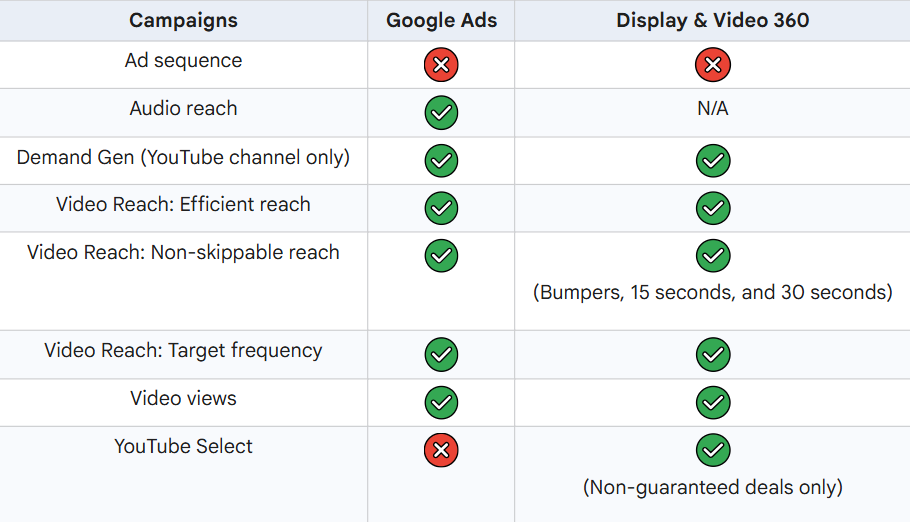
Microsoft Ads rolled out two upgrades that make policy issues and conversion delays easier to diagnose. Google is also expanding YouTube targeting with Partner Match using third-party audience data. Separately, Google Docs hints at a new Website Optimizer built into Google Ads and linked to GA4.
The Breakdown:
1. Asset Control: Microsoft Ads disapproves only of the failing asset, like one headline image or text line, not the entire ad. Campaigns keep running while you fix the broken piece. That reduces wasted spend and prevents avoidable pauses.
2. Conversion Lag: Microsoft Ads now exposes conversion delay so optimization is less guesswork. You can see the average time for 90% of conversions to register after a click. That improves bidding timing, pacing, and performance readouts.
3. Partner Match: Google Ads adds Partner Match to build YouTube audiences from eligible third-party partner data. It securely matches identifiers like emails and phone numbers to Google accounts. It applies to Video Reach, Video Views, and Demand Gen, excluding UK, Switzerland, and EEA targeting.
4. Site Testing: Google help docs point to a revived Website Optimizer inside Google Ads tied to GA4. It appears designed to simplify experimentation and landing page optimization without external tools. For now, it reads as an early test surfaced through documentation.
These updates push ad platforms toward fewer operational shocks and more measurable feedback loops. You keep campaigns live while fixing small compliance issues, and you gain clearer timing signals for optimization, plus new audience building and testing infrastructure.
🏆 Ad of the Day
What Works:
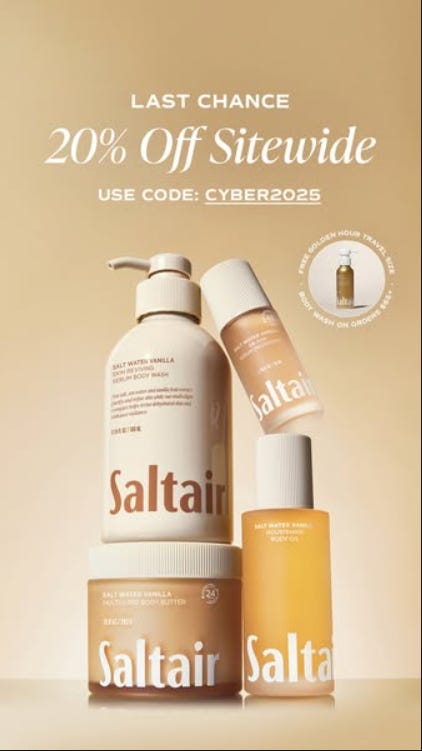
1) The entire palette mimics “golden hour,”- The warm beige-to-gold gradient activates emotional coziness, a sensory cue that primes “self-care indulgence” before the viewer even reads the 20% off.
2) “LAST CHANCE” positioned above the discount - People read top-down, so urgency precedes reward, activating loss aversion before presenting the benefit. This sequencing is intentional: scarcity first, decision second.
3) The small circular inset - The tiny “Golden Hour Thalassa” giveaway badge is strategically placed at the periphery to behave like a whispered perk. It gives the discount a bonus layer without overwhelming the hero stack.
This ad works because it doesn’t scream “SALE” it frames the discount inside a world of sensory warmth, ritual, and composure. It sells self-care elevated by scarcity, making 20% off feel like an invitation into a calmer, more beautiful version of daily life.
Advertise with Us
Wanna put out your message in front of over 50,000 best marketers and decision makers?
We are concerned about everything DTC and its winning strategies. If you liked what you read, why not join the 50k+ marketers from 13k+ DTC brands who have already subscribed? Just follow this.
At ScaleUP, we care about our readers and want to provide the best possible experience. That's why we always look for ways to improve our content and connect with our audience. If you'd like to stay in touch, be sure to follow us EVERYWHERE🥰
Thanks for your support :) We'll be back again with more such content 🥳