
Howdy Readers 🥰

In this newsletter, you’ll find:
🎯 The target you should have pushed back on three months ago
📊 Google is giving advertisers more data, more ad placements and cleaner analytics
🏆 Ad of the day
If you’re new to ScaleUP then a hearty welcome to you. You’ve reached the right place along with 50k+ CEOs, CMOS, and marketers. Let’s get into it, shall we? Oh! Before you forget, if someone forwarded this newsletter to you, don't forget to subscribe to our newsletter so you never miss out!
Together with Insense
DTC marketers: Your FREE Sept→Jan creator playbook for BFCM + Q5

By October, CPMs can already be 20–60% higher. Waiting until November leaves your team buying expensive attention while still chasing creators, approvals, and usable content.
Insense’s free BFCM + Q5 Creator Marketing Playbook gives DTC marketers a week-by-week plan from September through January, so every creator campaign starts with a clear deadline and purpose.
Inside, you’ll learn how to:
Adapt to four shifts that have changed how Q4 is won this year
How to source the right creators within 48 hours
Time organic and paid social campaigns across BFCM and the overlooked mid-December-to-January Q5 window.
Get the free playbook and turn the busiest selling season into a campaign your team can execute without last-minute scrambling.
Insense is the creator engine for consumer brands scaling past $2M, looking to save 40+ hours on creator operations per month - especially in Q4.
Book a free strategy call by October 9th and get $200 towards your first campaign.
🎯 The target you should have pushed back on three months ago
Absorbing an unrealistic target quietly feels like the safer move in the moment.
Pushing back risks an uncomfortable conversation.
Absorbing it just means working harder against a number that was never actually achievable with the resources attached to it. The second option feels safer and is usually more expensive, since it postpones the same hard conversation to a point where less time is left to fix anything.
The skill worth building isn’t pushing back on every target. It’s knowing which targets are worth absorbing and which ones need a conversation before the quarter starts, not after it’s already gone sideways.
Run the math before accepting the number
A target arrives from leadership already framed as a decision, not a proposal, which makes it easy to skip the step of actually checking whether it’s achievable before agreeing to it.
Before accepting, model what the target requires against current capacity: pipeline per rep, content output per cycle, whatever the underlying unit is for the goal.
If the math doesn’t close even under generous assumptions, that’s information worth surfacing before the quarter starts, not a problem to discover in week ten.
Push back with a specific trade, not a general objection
“This isn’t realistic” is easy to dismiss because it offers nothing to negotiate against. A specific trade is harder to wave off, because it forces a real decision instead of a mood.
Bring one of three things to the conversation:
The resource gap that needs closing to hit the number as stated
The lower number that’s achievable with current resources
The specific lower-priority work you’d need to stop doing to free up capacity for the new target
Each of those is a decision leadership can actually make. A general objection isn’t.
Protect the work that’s already moving pipeline while you negotiate
The riskiest failure mode isn’t losing the pushback conversation. It’s letting the work that’s currently producing results get deprioritized while the target conversation is still unresolved.
Keep whatever is demonstrably driving pipeline running at full resourcing through the negotiation, even if that means visibly under-resourcing something else in the interim.
A stalled pushback conversation shouldn’t be allowed to quietly starve the one thing that’s actually working. Knowing which channel is actually earning that pipeline matters more than ever now that a meaningful share of buyer research happens inside AI tools instead of a search results page.
Foundation CEO Ross Simmonds and AirOps’ Josh Spilker are unpacking exactly that on September 29, using research across nearly 380,000 AI answers and 3 million citations to show which sources are actually shaping which brands make a buyer’s shortlist. You can secure your free spot here.
Every target you absorb without checking the math first is a decision, even when it doesn’t feel like one.
📊 Google is giving advertisers more data, more ad placements and cleaner analytics
Google is rolling out updates across Customer Match, Demand Gen, and Google Analytics, changing how advertisers build audiences, reach shoppers, and filter the data behind campaign decisions.
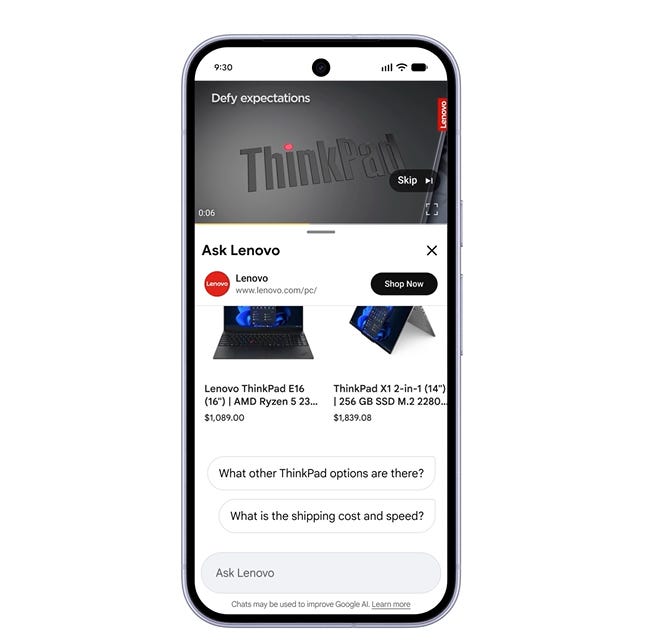
The Breakdown:
Demand Gen Expands - YouTube viewers can ask questions about products without leaving videos, while single-tap image ads are coming to Shorts and Gmail. Google says Gmail delivered 40% more conversions at the same ROI on average.
Customer Match Gets More Signals - Advertisers can now upload IP addresses and interaction timestamps alongside existing identifiers to improve matching. The new signals are unavailable for users in the EEA, UK and Switzerland.
Ads Come to Maps - New affiliate location extensions can promote business locations directly inside Google Maps, giving Demand Gen campaigns another way to reach consumers around physical stores.
Analytics Gets an Allowlist - Google Analytics can now accept traffic only from approved hostnames, automatically filtering other domains. Measurement Protocol events remain exempt from these Include filters.
Google is strengthening more parts of the advertising workflow at once. Customer Match gets additional first-party signals, Demand Gen gains new shopping and local placements, and Analytics gets a simpler way to keep spam out of reporting, giving marketers more control from audience building through measurement.
🏆 Ad of the day

What Works:
Bundle Logic Lands - “Better Together” instantly explains why the two products belong in one purchase, while “smooth, seal and nourish” gives each bundle a clear outcome-led reason to buy.
Offer Feels Obvious - The oversized 20% off treatment creates strong offer framing, and repeating the discount code near the CTA reduces conversion friction by making redemption feel straightforward.
Routine Feels Premium - The robe, soft lighting and close-up hands place the products inside a self-care ritual, adding lifestyle aspiration while keeping both SKUs visually central and recognizable.
Bundle two complementary products around one shared outcome, then make the savings impossible to miss. That combination strengthens perceived value without making the offer feel random.
Advertise with Us
Wanna put out your message in front of over 50,000 best marketers and decision makers?
We are concerned about everything DTC and its winning strategies. If you liked what you read, why not join the 50k+ marketers from 13k+ DTC brands who have already subscribed? Just follow this.
At ScaleUP, we care about our readers and want to provide the best possible experience. That's why we always look for ways to improve our content and connect with our audience. If you'd like to stay in touch, be sure to follow us EVERYWHERE🥰
Thanks for your support :) We'll be back again with more such content 🥳