
Howdy Readers 🥰
In this newsletter, you’ll find:
🕵️♂️ The “Distribution Gate” Theory
🤳 SMB Websites Are at a Crossroads as Search Fragments
🏆 Ad of the Day
If you’re new to ScaleUP then a hearty welcome to you, you’ve reached the right place along with 50k+ CEOs, CMOS, and marketers. Let’s get into it, shall we? Oh! Before you forget, if someone forwarded this newsletter to you, don't forget to subscribe to our newsletter so you never miss out!
Together with Tatari
Why Winning DTC Brands Are Getting Pickier About Their TV Partners

If you’ve been eyeing TV for 2026, you’ve seen the flood: hundreds of platforms promising to “unlock CTV for your brand.” Here’s what they’re not saying: who you pick determines whether TV becomes a growth channel or an expensive experiment.
Most new players are programmatic-only – limited transparency, low-quality supply, and measurement that crumbles the second you scale.
The brands actually winning on TV (Jones Road Beauty, Tecovas, Ridge Wallet, Calm) use partners who offer:
Not just programmatic, but linear, streaming, and direct publisher inventory
Full visibility into where ads ran
Outcomes measurement that actually works at scale
2026 will reward marketers who are thoughtful about their TV partners. The space is crowded, but the right choice actually moves the needle.
And don’t forget to gut-check those shiny offers. Free ad credits? Performance guarantees? If it sounds too good to be true, it is.
Start smart or switch to a reliable partner: Tatari.tv
🕵️♂️ The “Distribution Gate” Theory
Here is the pattern that kept showing up across accounts, and it took a while to name it.
Some ads do not lose in the auction. They never really enter it.
They get a little spend, a little reach, then Meta starts treating them like dead weight. CPM creeps. Delivery stalls. The team assumes competition got worse, or targeting broke, or the account is cursed.
But the symptoms do not match an auction problem.
They match a distribution problem. Meta is not just pricing attention. It is rationing attention, based on whether your ad will behave like the feed content people naturally reward.
So there is an invisible checkpoint happening upstream.
Not a policy review. A behavior prediction.
Meta is effectively asking, will people treat this like content, or will they label it as an ad in the first second and move on?
If the model predicts quick pattern recognition, it starts protecting the feed from you. Your ad is still eligible, but it is no longer trusted. It shows up less, and when it does, it has to pay more for worse conditions.
That is why the same ad can look fine in Ads Manager yet feel like it is dragging a trailer.
The telltale signature of a “distribution fail.”
Auction pressure and distribution failure look different when you know what to watch.
Auction pressure usually looks like CPM up while click intent holds. People still react, it just costs more.
Distribution failure appears as CPM increasing while attention and click intent decline simultaneously. CTR softens. Hook hold rate drops. Engagement thins out. The ad is not just expensive, it is being rationed.
That is the moment most teams make the wrong move. They try to outbid the problem. You cannot outbid being predicted as skippable.
The real enemy is recognizability.
The point is not that UGC is dead or templates are bad. The real enemy is when the viewer’s brain can instantly categorize the ad.
Once the brain predicts the rest, attention collapses. Then Meta learns, this is not worth distributing. You are not losing to competitors. You are losing to the feed’s memory of what “an ad” looks like.
The creative spec that reliably clears the checkpoint
The ads that clear this invisible gate do one thing consistently. They pay the viewer early. Not with a hook line. With a micro reward.
A simple build sequence that keeps working. A visual glitch or tension in the first beat. Immediate context so the brain knows what it is watching.
A quick payoff that earns the next second. Proof that turns curiosity into belief. Then the decision path.
That is why micro stories are winning. They are not prettier. They are harder to classify. In 2025, the game is not only about winning the auction. It is earning the right to be distributed before the auction even matters.
🤳 SMB Websites Are at a Crossroads as Search Fragments
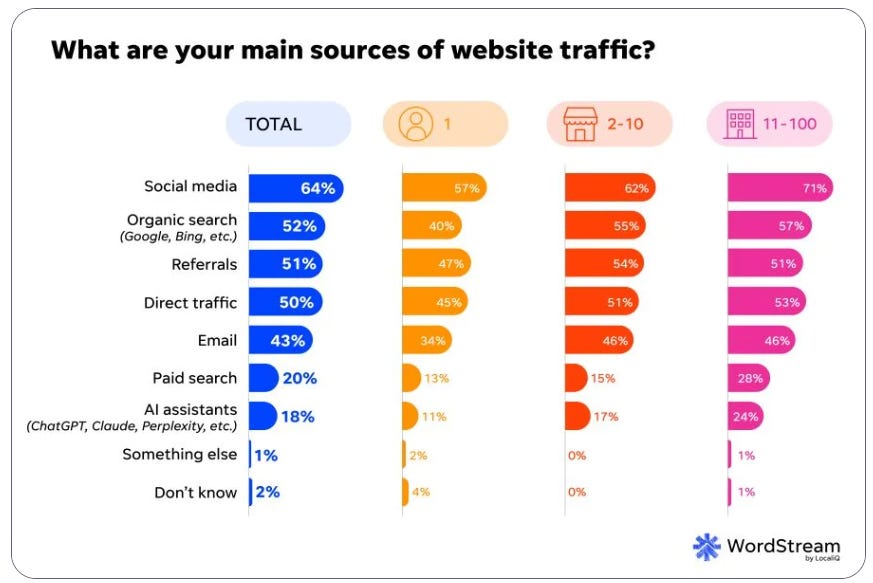
Small businesses are navigating a rapidly shifting search landscape where Google is no longer the only gateway to discovery. Social platforms, AI search engines, and GEO are reshaping how traffic arrives, and SMBs are adapting with limited resources.
The Breakdown:
1. Traffic Shift - Social media now outranks SEO as the top traffic driver, with 64% of SMBs relying on it versus 52% for organic search. Despite this shift, 69% still depend on websites for leads, and driving + converting traffic remains their biggest challenge.
2. SEO & GEO Reality - 72% say SEO is effective, even as 40% report traffic drops from AI overviews and algorithm changes. GEO familiarity is rising, and most SMB actions, clear headlines, readability, and structured data, mirror classic SEO, reducing the learning curve.
3. AI Search Impact - Half of SMBs now monitor AI referrals, with homepages, product pages, and About pages cited most. Top GEO hurdle: competitors appearing in AI answers. Many see AI as a traffic amplifier, but attribution remains difficult.
4. The Website Divide - One-third of SMBs still lack a website, with 43% saying they may never build one due to reliance on social, referrals, or marketplaces. Yet 94% of SMBs with websites say they’re important, and 61% say website traffic matters more than ever.
Search is no longer a single-channel game. SMBs must balance SEO, social, and emerging AI-powered discovery while improving on-site conversion to offset rising traffic volatility. Those who diversify presence across web, social, and GEO will stay discoverable as consumer search behavior splinters.
🏆 Ad of the Day

What Works:
1) “Everyone’s talking about” sells social safety - That line activates bandwagon logic and lowers taste-risk, because the buyer isn’t choosing alone anymore. It reframes the purchase as culturally validated, not personally debatable. When decor feels socially approved, hesitation drops fast.
2) The surfboard shape is a portable identity symbol - A surfboard on a wall is instantly legible as “coastal, relaxed, design-aware,” even if you never surf. It functions like a badge, not an art piece, compressing lifestyle signaling into one silhouette.
3) The room is staged to feel attainablel - Natural light, clean neutrals, and lived-in minimal props create a “this could be my home” realism. It avoids perfection intimidation, so the buyer can imagine the same transformation without feeling outclassed.
This ad wins by making decor feel like a culturally endorsed identity upgrade, demonstrated through a simple ritual in an attainable home. It sells the comfort of good taste more than the object itself.
Advertise with Us
Wanna put out your message in front of over 50,000 best marketers and decision makers?
We are concerned about everything DTC and its winning strategies. If you liked what you read, why not join the 50k+ marketers from 13k+ DTC brands who have already subscribed? Just follow this.
At ScaleUP, we care about our readers and want to provide the best possible experience. That's why we always look for ways to improve our content and connect with our audience. If you'd like to stay in touch, be sure to follow us EVERYWHERE🥰
Thanks for your support :) We'll be back again with more such content 🥳