
Howdy Readers 🥰

In this newsletter, you’ll find:
🫷 The Two Signals You’re Sending Google Are Contradicting Each Other.
📊 Document Posts Win on LinkedIn While Meta Quietly Sharpens Instagram Ad Targeting
🏆 Ad of the Day
If you’re new to ScaleUP then a hearty welcome to you. You’ve reached the right place along with 50k+ CEOs, CMOS, and marketers. Let’s get into it, shall we? Oh! Before you forget, if someone forwarded this newsletter to you, don't forget to subscribe to our newsletter so you never miss out!
🫷 The Two Signals You’re Sending Google Are Contradicting Each Other.
There’s a category of SEO damage that compounds silently for months before anyone connects it to a cause. No error flags. No manual actions. Just authority bleeding away from pages that should be consolidating it, because the sitemap and canonical tags are pointing Google in opposite directions at the same time.
When those two signals conflict, Google doesn’t pick the right one by default. It hesitates. And hesitation at the crawl level means the pages built to rank stop receiving the full weight of the signals pointing at them.
The four conflict types worth hunting down.
Export the full sitemap and cross-reference every URL against its canonical tag. The conflicts almost always fall into the same categories:
Paginated URLs: /page/2 and beyond that, canonicalize back to the root but remain in the sitemap, sending Google toward pages the site has explicitly marked non-authoritative
Parameter variants: filtered or sorted URLs like ?color=red or ?sort=price, sitting in the sitemap while canonicalizing to the clean version
Legacy protocol variants: HTTP or non-www versions that redirect correctly but were never scrubbed from the sitemap after migration
Self-referential canonical mismatches: the one most audits miss entirely
That fourth type is worth slowing down for. The page looks clean because the canonical is self-referencing.
But the sitemap submits a technically different URL, a trailing slash discrepancy, a subdomain inconsistency, and a protocol variation, and Google sees two different addresses claiming authority over the same content.
Invisible without a character-level comparison between the sitemap URL and the canonical tag on the page itself.
Fixing each conflict without creating new ones.
Paginated URLs leave the sitemap entirely unless each page carries genuinely unique content. Parameter URLs get blocked through Search Console’s URL parameter settings and removed from the sitemap immediately.
Legacy protocol variants get replaced with canonical equivalents, audit the redirect chains after to confirm no intermediate hops are absorbing equity before it reaches the destination.
Self-referential mismatches require exact matching: same protocol, same subdomain, same trailing slash treatment, character for character. Update the sitemap to reflect the precise URL the canonical references, validate with a fetch in Search Console, then resubmit.
Monitor the Coverage report for two to three weeks after resubmitting. A drop in excluded pages alongside rising valid indexed pages confirms authority is consolidating the way it should.
Fixing the sitemap gets pages indexed cleanly. Getting them cited in AI answers is the next frontier.
Join Eli Schwartz live on AirOps, April 15 at 2 PM EST, the strategist behind billions in organic revenue for Coinbase, LinkedIn, and Tinder, breaking down the exact framework for AI retrieval in 2026. You can register free. Recording within 24 hours.
A conflicted sitemap actively works against rankings. A clean one simply stops doing damage.
What happens after that depends entirely on what the content gives AI a reason to retrieve.
📊 Document Posts Win on LinkedIn While Meta Quietly Sharpens Instagram Ad Targeting
Socialinsider’s 2026 LinkedIn Benchmarks report analyzed 1.3 million posts from 16,645 business pages between January 2024 and December 2025. Meanwhile, Meta rolled out a new AI ranking model, already lifting Instagram ad performance.
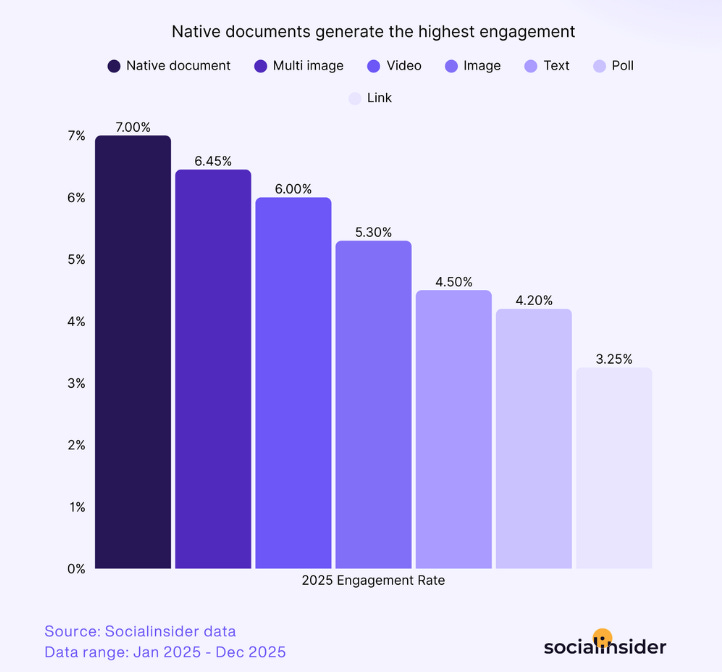
The Breakdown:
PDFs Beat Video - Native document posts drive more engagement than image or video on LinkedIn, though a lower volume of document posts in the sample could skew results, but original research and insights consistently perform especially well in this format.
Likes Favour Images - Multi-image posts generate the most likes on LinkedIn, followed by single images and video, but optimising for likes alone could mean posting less engaging content overall, so know which metric actually matters.
Smarter Instagram Ads - Meta’s new Adaptive Ranking Model uses LLM-scale intelligence to read user context and intent in real time, delivering +3% more conversions and +5% higher click-through rates since Q4 2025 with less compute.
Already Working Automatically - The model replaces the old approach with intelligent request routing that matches ads based on behaviour not just demographics, meaning your existing campaigns could already be performing better without any changes needed.
If you post on LinkedIn, test document posts with original insights before defaulting to video. If you run Instagram ads, your targeting just got sharper without you doing anything. Both updates reward people paying attention.
🏆 Ad of the Day

What Works:
The Hidden Conversion Mechanism
This ad works by diagnosing before selling. It pulls the viewer into self-assessment mode, making them mentally check off symptoms, which creates internal agreement before the product even appears. Once you self-identify, resistance drops.
It also shifts blame from the person to the current routine, protecting ego while opening the door to change. You’re not the problem, your stack is.
The question at the end forces a yes-state, priming action.
Make your ad a diagnosis first. When people recognize themselves in the problem, they’ll seek your solution automatically.
Advertise with Us
Wanna put out your message in front of over 50,000 best marketers and decision makers?
We are concerned about everything DTC and its winning strategies. If you liked what you read, why not join the 50k+ marketers from 13k+ DTC brands who have already subscribed? Just follow this.
At ScaleUP, we care about our readers and want to provide the best possible experience. That's why we always look for ways to improve our content and connect with our audience. If you'd like to stay in touch, be sure to follow us EVERYWHERE🥰
Thanks for your support :) We'll be back again with more such content 🥳