
Howdy Readers 🥰

In this newsletter, you’ll find:
💰 The budget ask that actually survives the meeting
📊 Google is reworking how advertisers use data, reporting and AI search
🏆 Ad of the day
If you’re new to ScaleUP then a hearty welcome to you. You’ve reached the right place along with 50k+ CEOs, CMOS, and marketers. Let’s get into it, shall we? Oh! Before you forget, if someone forwarded this newsletter to you, don't forget to subscribe to our newsletter so you never miss out!
Together with Insense
Save 40+ hrs/month in Q4 on UGC creator & influencer operations

Your team already runs on Slack and AI agents. Your creator marketing should too.
Insense now plugs into the stack you already use, so you brief, approve, and track creator work without living in yet another dashboard.
Route campaigns and updates through Slack, put your AI agents (ChatGPT, Claude) to work on briefs and shortlists, and keep everything connected to your Ads Manager and analytics.
Underneath, the creator layer runs itself:
Vetted creators apply to you within 48 hours - from a vetted marketplace of 115K+ creators across 57+ countries
Run diverse campaign types - from UGC to seeding, influencer posting, and Meta Partnership Ads and TikTok Spark Ads
Get creator performance insights - connect your Ads Manager and view which creators perform best - not only which ads
Over 3,500 brands and agencies use Insense, with first creator applications arriving within 48 hours and teams saving 40+ hours monthly.
Book a free strategy call by Sept 25th and get $200 towards your first campaign.
💰 The budget ask that actually survives the meeting
Most budget requests fail for a reason nobody names out loud: they argue for more resources by describing more work, not more pipeline.
A request built around headcount, tools, or workload sounds reasonable to the person making it and sounds like a cost center to the person approving it. The gap between those two readings is where most asks die.
The fix isn’t a bigger deck. It’s a different unit of argument. Every line in the request needs to trace to a specific pipeline outcome, not a category of activity.
Rewrite the ask around what stops moving, not what you’d add
Instead of listing what a new hire or tool would let you start doing, list the pipeline-moving work currently not happening because of the resource gap, and name a number against it.
This forces a harder but more honest version of the request. “We need a content ops hire” becomes “we have 40 qualified opportunities a quarter stalling because sales enablement content ships six weeks late, and closing that gap is worth an estimated X in pipeline.”
This is exactly the operating shift 300+ marketing leaders described in a report Krithika Shankarraman, the first marketing hire at Stripe and OpenAI, and AirOps CMO Christy Roach are unpacking on September 17: 75.4% face higher pipeline or revenue targets, and only 43% got a budget increase to match.
Separate the resource math from the workload math
A budget conversation and a headcount conversation are actually two different arguments, and conflating them weakens both.
Model what the team could produce with current resources at full efficiency first, then show the gap between that ceiling and what the target requires.
If the gap is real after efficiency is accounted for, the ask is defensible. If the ceiling was never actually tested, the ask is premature, and that’s worth knowing before walking into the room.
Bring the counterfactual, not just the ask
A request that only shows the upside of approval never gets seriously debated. One that shows the cost of no change does.
Model what happens to the pipeline number if nothing changes for two more quarters, using the same trend line leadership is already watching. Sitting that next to the resource ask turns the conversation from “can we afford this” into “can we afford not to.”
You can reserve your free spot to hear how Krithika and Christy are framing that gap for teams closing it right now. A budget request that describes work invites a debate about cost. One that describes pipeline invites a debate about ROI, and that’s the debate worth having.
📊 Google is reworking how advertisers use data, reporting and AI search
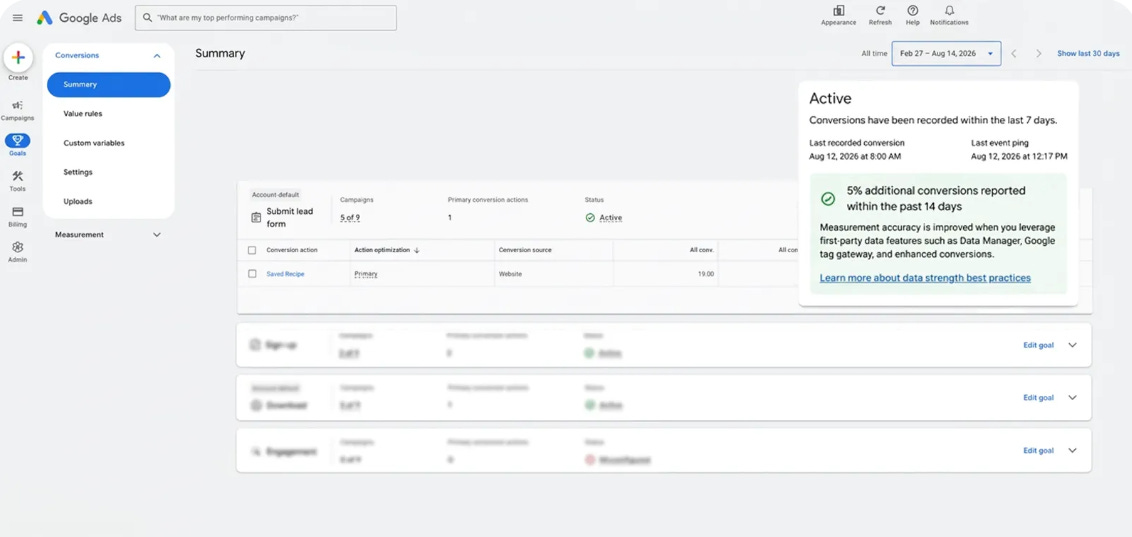
Google is expanding Data Manager, launching customizable Google Analytics Dashboards, and testing exact and phrase match Search campaigns inside AI Mode, bringing first-party data, reporting and traditional keyword targeting deeper into its AI-powered advertising stack.
The Breakdown:
First-party data feeds more of Google’s ad stack - Data Manager can now send owned customer and sales data into Google Analytics and Display & Video 360. Google says advertisers connecting offline and app data see 26% higher incremental ROAS on average.
Meridian gets AI-powered measurement tools - Google is adding agentic capabilities to help audit data, fix errors and guide model building, alongside more brand signals and expanded GeoX access for geography-based incrementality experiments.
Google Analytics gets customizable Dashboards - Marketers can drag, resize and arrange six visualization types on a single canvas, then publish dashboards directly into Reports for property-wide performance monitoring.
Traditional Search ads enter AI Mode - Google is testing exact and phrase match keywords in AI Mode when queries show “explicit and direct user intent,” giving conventional Search campaigns exposure without requiring AI Max or Performance Max.
Google is connecting more of the advertising workflow around AI, from feeding first-party data into targeting and measuring incrementality to simplifying reporting and extending existing Search campaigns into AI Mode. Advertisers gain new tools while Google’s systems take a larger role in deciding how data gets activated.
🏆 Ad of the day

What Works:
Ingredients Build Credibility - The product is surrounded by recognizable ingredients, making the formula feel transparent and tangible while helping shoppers connect each component to a specific functional benefit.
Benefits Stay Scannable - Rosemary, Dead Sea salt, coconut and cedarwood each get their own callout, reducing cognitive load and turning a complex formula into quick, easy-to-process proof points.
Product Anchors Attention - The large bottle stays centered while ingredients radiate around it, creating strong visual hierarchy and reinforcing branding recall without letting educational copy overpower the hero SKU.
Place hero ingredients physically around the product and assign one clear benefit to each. This turns formulation details into visual proof instead of dense ingredient-list copy.
Advertise with Us
Wanna put out your message in front of over 50,000 best marketers and decision makers?
We are concerned about everything DTC and its winning strategies. If you liked what you read, why not join the 50k+ marketers from 13k+ DTC brands who have already subscribed? Just follow this.
At ScaleUP, we care about our readers and want to provide the best possible experience. That's why we always look for ways to improve our content and connect with our audience. If you'd like to stay in touch, be sure to follow us EVERYWHERE🥰
Thanks for your support :) We'll be back again with more such content 🥳