
Howdy Readers 🥰
In this newsletter, you’ll find:
⚡️Your traffic dropped. You have 200 pages to audit. Here’s how to do it in one sitting.
🔍 Microsoft Expands AI, Ecommerce, And B2B Advertising Tools
🏆 Ad of the Day
If you’re new to ScaleUP then a hearty welcome to you. You’ve reached the right place along with 50k+ CEOs, CMOS, and marketers. Let’s get into it, shall we? Oh! Before you forget, if someone forwarded this newsletter to you, don't forget to subscribe to our newsletter so you never miss out!
⚡️Your traffic dropped. You have 200 pages to audit. Here’s how to do it in one sitting.
The instinct after a core update is to audit everything. Export all URLs, build a spreadsheet, review page by page. Three weeks later, you’ve diagnosed the problem and lost another month of traffic while doing it.
There’s a faster way. One that gets you to your first recovery action within 48 hours.
Start with one date filter, not a full audit
Open Google Search Console. Pull performance data for the 60 days straddling the update rollout. Filter pages with impression drops of more than 30% compared to the prior period.
That filtered list is your audit. Not your entire index. The pages outside it aren’t your problem right now, and treating them as such is what turns a two-day triage into a three-week distraction.
Sort by highest pre-update traffic first. The pages at the top of that list are where your recovery effort compounds fastest.
Run every impacted page through a three-bucket classification
Before touching a single word of content, classify each impacted page into one of three buckets:
Recoverable: Page has a genuine unique angle, original data, first-person experience, proprietary methodology, but lost rankings due to collateral update impact. These get one unreplicable signal strengthened and a reindex request submitted.
Consolidate: Page covers the same topic as a stronger asset in your index with more authority and better differentiation. Redirect it. Let the stronger page absorb whatever equity is worth preserving.
Remove: No unique angle, no recovery path, no consolidation candidate. Noindex it. Commodity content dragging down pages around it is worse than no content at all.
The classification determines the action. Not the size of the traffic drop. A page that lost 80% of its traffic but has genuine differentiation is a recovery priority. A page that lost 20% with nothing unique behind it gets removed.
Once classified, track whether recovery actions are moving AI visibility alongside organic rankings. *SEMrush’s AI Visibility Toolkit shows visibility across ChatGPT and Google AI Mode so you can confirm recovered pages are gaining retrieval on both surfaces not just traditional search. You can try it for free for 7 days.
Run the replicability test only on recoverable pages
Open ChatGPT. Type the core premise of each recoverable page as a prompt. Compare the output to your content.
If the outputs are functionally identical, the page was misclassified. Move it to consolidate or remove. If the output is meaningfully different, the page has a genuine differentiation signal worth strengthening.
This test takes two minutes per page. Running it on your entire index wastes the time you should be spending on recovery. Running it only on recoverable pages makes it the most efficient diagnostic in your workflow.
Two days to triage. First recovery action live before the week is out.
🔍 Microsoft Expands AI, Ecommerce, And B2B Advertising Tools
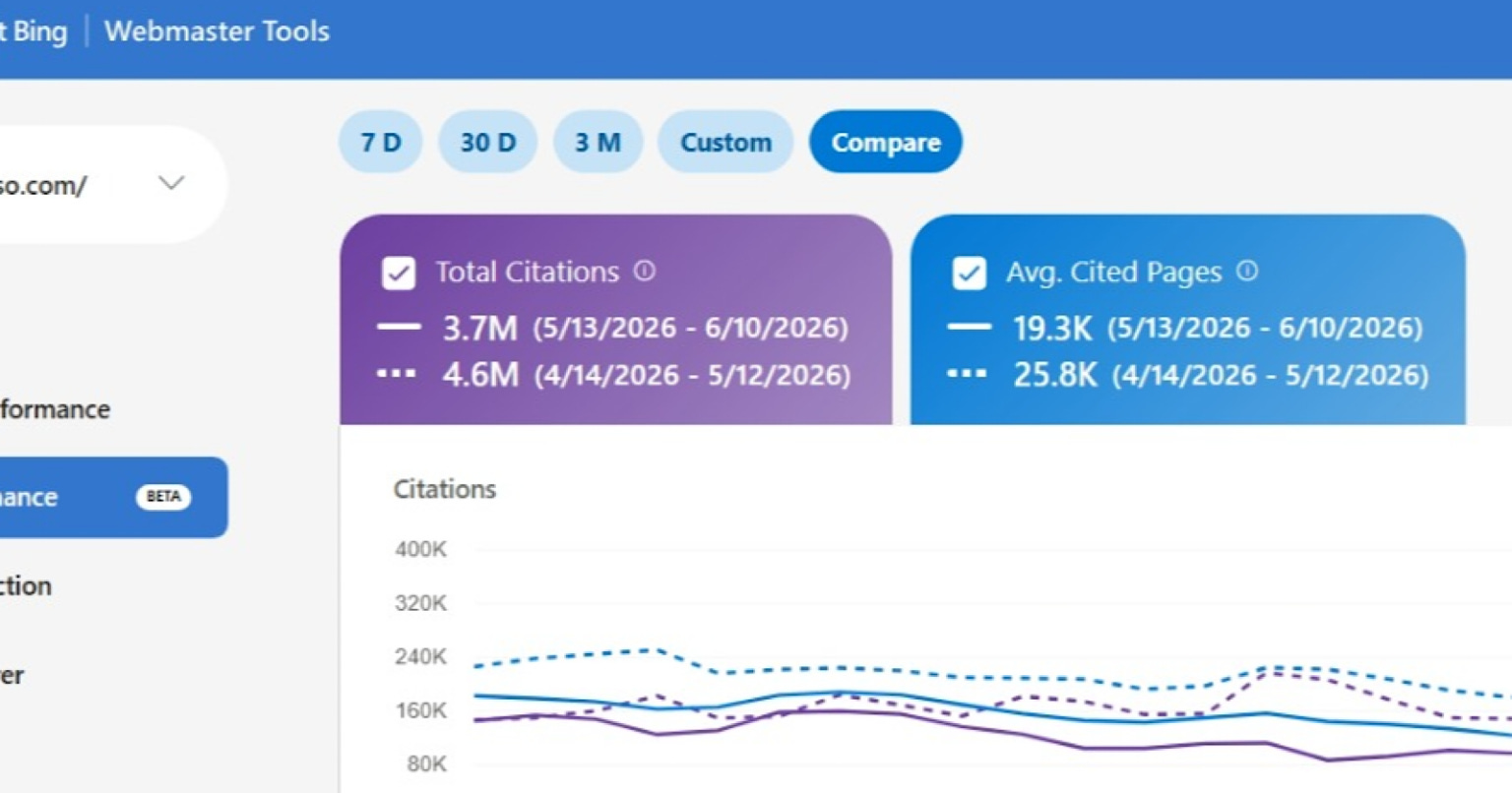
Microsoft rolled out a wave of updates across Bing Webmaster Tools and Microsoft Advertising, giving marketers better visibility into AI citations, product feed performance, and B2B audiences. The goal is simple: make it easier to understand what’s driving visibility, engagement, and conversions.
The Breakdown:
AI Visibility Insights - Bing Webmaster Tools added Citation Share, Intents, Topics, and Compare to its AI Performance dashboard. Marketers can now see their share of AI citations, group visibility by topics or intent, and compare performance across different time periods.
Product Feed Control - Microsoft launched Product Explorer, a new Merchant Center tool that helps advertisers identify serving, rejected, and underperforming products. Users can filter catalogs by metrics like impressions, clicks, conversions, CTR, and spend from one interface.
Faster Optimization Workflows - Product Explorer also connects with Recommended Actions, helping advertisers diagnose feed issues and improve product eligibility. The tool is currently available to U.S. advertisers managing fewer than 100,000 SKUs.
LinkedIn-Powered Targeting - Microsoft Ads expanded LinkedIn targeting with job seniority filters across Search and Audience campaigns. Advertisers can now target or analyze audiences across ten levels, including CXO, VP, Director, Manager, and Entry-level professionals.
Microsoft is strengthening its position across SEO, ecommerce, and B2B advertising. The updates give marketers clearer AI visibility data, easier product feed management, and more precise professional targeting, helping turn Microsoft’s ecosystem into a more competitive marketing platform.
🏆 Ad of the Day

What Works:
Root-Cause Framing - “Treats Acne’s Root Causes” positions the supplement as fundamentally different from topical solutions. The product feels corrective rather than temporary.
Risk Reversal - The money-back guarantee neutralizes fear of wasting money. High-skepticism categories often scale when purchase risk approaches zero.
Social Validation - “3,000+ Reviews” signals market acceptance. Consumers assume enough people have already tested the product, reducing perceived experimentation risk.
In categories with high consumer skepticism, don’t rely on a single proof mechanism. Stack authority, social proof, risk reversal, and differentiation together so consumers don’t have to make a leap of faith, only a small step.
💃Events
🔥 Why Some Pages Get Cited In AI Search While Higher Rankings Get Ignored
Today | 60 Minutes | Virtual Event
Google’s AI Mode is changing how buyers discover brands, and rankings alone no longer guarantee visibility. Learn the content signals AI uses to choose citations, how to identify visibility gaps before they cost pipeline, and the workflows top B2B teams are using to earn references in AI answers, with insights from Chris Long, co-founder of Nectiv.
Can’t make it live? Register anyway, you’ll get the recordings within 24hours.
*When you purchase through links in this article, we may earn an affiliate commission from Semrush.
Advertise with Us
Wanna put out your message in front of over 50,000 best marketers and decision makers?
We are concerned about everything DTC and its winning strategies. If you liked what you read, why not join the 50k+ marketers from 13k+ DTC brands who have already subscribed? Just follow this.
At ScaleUP, we care about our readers and want to provide the best possible experience. That's why we always look for ways to improve our content and connect with our audience. If you'd like to stay in touch, be sure to follow us EVERYWHERE🥰
Thanks for your support :) We'll be back again with more such content 🥳