
Howdy Readers 🥰

In this newsletter, you’ll find:
🧐Your Popup Is Converting. That’s Exactly the Problem.
🔍 Google Dropped Several Updates for SEOs and Advertisers This Week
🏆 Ad of the Day
If you’re new to ScaleUP then a hearty welcome to you. You’ve reached the right place along with 50k+ CEOs, CMOS, and marketers. Let’s get into it, shall we? Oh! Before you forget, if someone forwarded this newsletter to you, don't forget to subscribe to our newsletter so you never miss out!
Together with Templafy
Your team is prompting AI decks. Your brand has no idea.

Every presentation your team generates without guardrails is a brand liability waiting to happen.
Templafy works inside PowerPoint. You set the brand rules, approved assets, and content guardrails once. Every AI-generated deck your team builds after that follows them automatically.
Brand rules are enforced on every AI-generated deck
Client-ready presentations that are on-message by default
4M+ users at Adobe, KPMG, and Pandora are already running on it
BDO saved $1.65M in a year. Adobe teams got back 72% of their time. Your brand shows up right, every time, without you having to police it.
🧐Your Popup Is Converting. That’s Exactly the Problem.
Your opt-in rate looks healthy. Your 10-minute conversion window is about to tell you why that’s bad news.
A cold visitor doesn’t engage with a pop-up before they’ve decided whether they trust the brand or understand the product. Intent comes before discount-seeking. So when the majority of your email captures convert within 10 minutes of signing up, your pop-up isn’t creating purchase intent. It’s intercepting it. Those visitors were already going to buy.
Your opt-in rate is measuring interception efficiency, not acquisition efficiency. Two completely different things, and only one of them actually grows your customer base.
Five Strategies Nobody Is Running
1. Gate your popup behind scroll depth, not time. Replace time-delay triggers with a 65% scroll depth threshold. A visitor who has read two-thirds of your product page has formed an opinion. That’s the first moment a capture attempt is logically justified. Entry popups collect people who haven’t decided anything yet, scroll-gated popups collect people who almost have.
2. Split your list by time-to-conversion and treat them as different audiences. Pull every email capture from the last 90 days and filter by how quickly they converted after signup. Captures converting inside 10 minutes are warm traffic, returners, existing customers, high-intent arrivals.
Captures that didn’t convert within 24 hours are your actual cold acquisition list. They need completely different messaging, different cadence, and different offers. Running the same welcome sequence across both cohorts is why your open rates look fine, but your revenue per subscriber doesn’t.
3. Run a no-discount capture test for 30 days. Replace the percentage-off offer with a value-forward hook, early access, a buying guide, or a product quiz result. Measure list quality by 30-day revenue per subscriber, not opt-in rate.
Discount captures inflate the list with deal-seekers. Value captures attract undecided visitors who need information to convert, a fundamentally more profitable cohort to own.
4. Use exit-intent timing exclusively for discount delivery. A visitor who has browsed, evaluated, and is leaving has formed a price opinion. That’s the only moment a discount offer is logically positioned; it’s removing a specific barrier that already exists. Entry discounts create a barrier that wasn’t there: now the visitor won’t buy without one.
5. Build a separate automation track for 24-hour non-converters. This is where platforms like Omnisend change the equation, letting you segment captures by conversion behavior automatically and trigger distinct sequences for cold subscribers without manual list management.
A visitor who didn’t convert in 24 hours isn’t lost. They’re unconvinced. That requires a different sequence entirely, not the same welcome flow on a longer delay. You can try Omnisend for free today!
Your pop-up’s best numbers are hiding its worst problem. The 10-minute window isn’t a metric to celebrate. It’s a mirror.
🔍 Google Dropped Several Updates for SEOs and Advertisers This Week
From clearing up a long-standing SEO myth to retiring a key API, Google had a busy week across search and ads. Here is everything that matters.
The Breakdown:
No Such Thing as Link Cooties - Google’s John Mueller confirmed that sites with link penalties do not pass negative signals through their outbound links. Google simply ignores low-quality links entirely; they neither pass value nor harm the sites they point to.
Merchant API Replaces Content API by August - Google Ads scripts will support the new Merchant API from April 22nd, with the Content API for Shopping retiring on August 18th. The new API adds generative AI tools, modular architecture, and real-time notifications; migration is not optional.
Enhanced Conversions Getting a Single Toggle - Google Ads is merging enhanced conversions for web and leads into one unified feature with a single on/off switch from June 2026. Advertisers can now send data through multiple sources simultaneously, tags, Data Manager, and API, without choosing one method.
Your Mobile Pages Are Too Heavy - Average mobile page weight has grown from 845KB in 2015 to 2.3MB today, three times heavier than a decade ago. Slower pages mean fewer conversions; trimming page weight is one of the most straightforward performance wins available.
The Merchant API migration deadline is August 18th; that is the most time-sensitive update here. Enhanced conversions are a set-and-forget win once live. And if your mobile pages are still carrying excess weight, that is worth fixing before it starts showing up in your numbers.
🏆 Ad of the Day
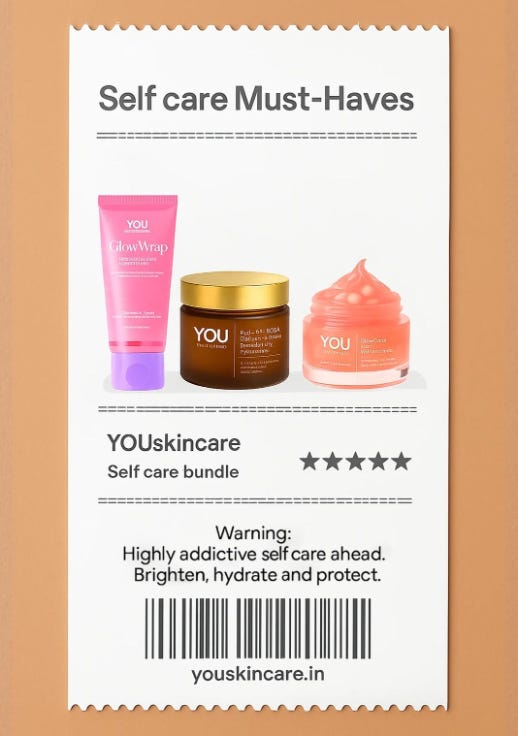
What Works:
The Hidden Conversion Mechanism
This ad disguises itself as a receipt, not an ad, which subconsciously signals that this has already been bought and validated. You’re not discovering it, you’re seeing proof of a purchase. That shifts you from evaluation to imitation.
“Self care must-haves” frames the bundle as a category standard, not a choice, implying these are the baseline products you should already own.
The barcode and layout create a retail realism effect, making it feel tangible and already circulating. Make your ad look like evidence of purchase, not promotion. People trust what feels already chosen.
Advertise with Us
Wanna put out your message in front of over 50,000 best marketers and decision makers?
We are concerned about everything DTC and its winning strategies. If you liked what you read, why not join the 50k+ marketers from 13k+ DTC brands who have already subscribed? Just follow this.
At ScaleUP, we care about our readers and want to provide the best possible experience. That's why we always look for ways to improve our content and connect with our audience. If you'd like to stay in touch, be sure to follow us EVERYWHERE🥰
Thanks for your support :) We'll be back again with more such content 🥳