
Howdy Readers 🥰

In this newsletter, you’ll find:
📹 Test the attention floor
🛍️ Meta And Pinterest Double Down On AI Shopping
🏆 Ad of the Day
If you’re new to ScaleUP then a hearty welcome to you. You’ve reached the right place along with 50k+ CEOs, CMOS, and marketers. Let’s get into it, shall we? Oh! Before you forget, if someone forwarded this newsletter to you, don't forget to subscribe to our newsletter so you never miss out!
📹 Test the attention floor
The conversation goes the same way every time. The video underperforms, someone asks whether a higher-quality production would have saved it, and the answer is no. The harder answer, the one the brief never surfaces, is why.
1. Diagnose the Attention Floor Before You Brief
The attention floor is the minimum level of narrative tension required to keep a viewer in a feed environment where they can leave in under a second. Feature-based communication falls below it structurally because features answer the question “what does this do?” and that question is not urgent enough to compete with everything else in the feed.
Before your next brief, run your last five video creatives through one diagnostic: does the viewer need to know how this ends? If the answer is no at the five-second mark, you are below the floor. Production quality is irrelevant from that point forward.
2. Translate Features Into Experiences Before a Script Exists
Unlike features, which describe capabilities, experiences implicate the viewer in an outcome they already care about. The translation works on one axis: what does the customer feel, lose, or win because of this feature?
Run every feature through this reframe before the brief leaves the room:
The feature: faster checkout
The experience: the customer who nearly abandoned the cart, and did not
The villain: every friction point that cost you sales you never saw in your data
The experience version produces a script. The feature version produces a product sheet.
3. Hand Rational Communication Off to the Right Funnel Layer
Video is not where rational evaluation happens and it was never designed to be. The spec sheet, the comparison table, the third-party review: these belong downstream, surfaced after video has already generated enough tension to make the rational case feel worth reading.
Structure it as a handoff: video establishes why this matters, the landing page delivers how it works, and email carries the proof. Trying to compress all three into a 30-second creative is not a production problem. It is a funnel architecture problem.
When each layer does its actual job, the whole thing converts.
🛍️ Meta And Pinterest Double Down On AI Shopping
Shopping platforms are becoming AI platforms. Meta and Pinterest both announced new tools aimed at making product discovery, creator commerce, and ad performance more automated and personalized.

The Breakdown:
Livestream Commerce Expansion - Meta is bringing live video ads to Instagram and rolling them out globally on Facebook. Viewers can browse featured products, check pricing, and shop directly during broadcasts without leaving the livestream.
Creator Sales Growth - Meta expanded affiliate partnerships with Flipkart, Mercado Libre, and Lazada, while enabling creators in 22 countries to tag products and earn commissions directly through Instagram.
AI Advertising Assistant - Pinterest launched a new AI business assistant inside Ads Manager that acts as a campaign advisor. The tool analyzes account performance, surfaces recommendations, and uses platform insights to help advertisers improve results without digging through reports manually.
Smarter Product Discovery - Pinterest launched Ask Pinterest, dynamic creative optimization, and AI reporting tools, helping shoppers navigate complex purchase decisions through conversational recommendations and personalized discovery.
Meta is focused on turning creators and livestreams into stronger shopping engines, while Pinterest is building AI tools that help advertisers optimize campaigns and help consumers make more informed purchase decisions.
🏆 Ad of the Day
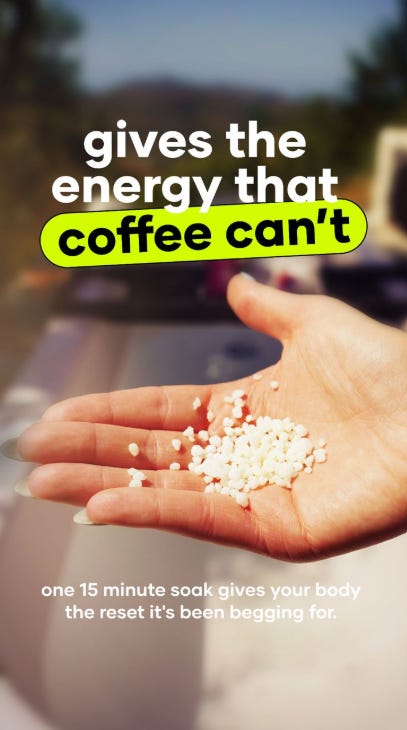
What Works:
Enemy Creation - “Energy that coffee can’t” instantly creates differentiation. The product doesn’t enter the energy category. It positions itself as the solution after energy solutions fail.
Category Inversion - Most wellness products promise stimulation. This one promises restoration. That reversal stands out because it challenges conventional energy habits.
Pain Recognition - The ad targets consumers trapped in the caffeine cycle of temporary boosts followed by crashes. The audience immediately recognizes the frustration.
Don’t always compare yourself to direct competitors. Compare yourself to the default behavior consumers already rely on. If you can expose the limitation of the status quo, your product becomes the alternative rather than just another option.
Advertise with Us
Wanna put out your message in front of over 50,000 best marketers and decision makers?
We are concerned about everything DTC and its winning strategies. If you liked what you read, why not join the 50k+ marketers from 13k+ DTC brands who have already subscribed? Just follow this.
At ScaleUP, we care about our readers and want to provide the best possible experience. That's why we always look for ways to improve our content and connect with our audience. If you'd like to stay in touch, be sure to follow us EVERYWHERE🥰
Thanks for your support :) We'll be back again with more such content 🥳