
Howdy Readers 🥰
In this newsletter, you’ll find:
⚠️ This Launch Strategy is Your TikTok Shop Potential
🔍 Google Ads Has Quietly Moved Beyond Keywords
🏆 Ad of the Day
If you’re new to ScaleUP then a hearty welcome to you, you’ve reached the right place along with 50k+ CEOs, CMOS, and marketers. Let’s get into it, shall we? Oh! Before you forget, if someone forwarded this newsletter to you, don't forget to subscribe to our newsletter so you never miss out!
⚠️ This Launch Strategy is Your TikTok Shop Potential
The fastest way to stall a TikTok Shop launch is to give the platform too many decisions at once. When a brand launches four or five products together, it isn’t being ambitious; it’s creating uncertainty inside a system that learns through repetition.
TikTok Shop doesn’t behave like a catalog-driven marketplace at the start. It behaves like a pattern-recognition engine that wants one clean loop to study. One product, one promise, one behavioral response it can validate at scale. When that loop fractures, distribution hesitates.
I’ve seen launches with strong demand flatline simply because the algorithm never got a single, repeatable answer to “what should I push harder?”
Early TikTok Shop Is a Learning Phase, Not a Selling Phase
At launch, TikTok is not optimizing for revenue maximization. It’s optimizing for confidence. The system is watching how often a product is clicked, how long people linger, where they hesitate, and whether creators can explain it without confusion.
When multiple SKUs enter simultaneously, those signals collide. Different prices create different trust thresholds. Different use cases attract different viewers. The cost is slower learning and diluted momentum.
The fix isn’t better creative. It’s a constraint. Pick one product and remove all competing variables until the platform knows exactly what success looks like.
The Hero SKU Is an Algorithmic Shortcut
Choosing a hero SKU is not a merchandising decision. It’s a training decision.
Products that work best early usually compress understanding fast. The value is obvious, the outcome is visible, and the purchase doesn’t require extensive justification. That clarity lets TikTok identify who converts and why, then replicate that pattern aggressively.
Once that happens, something subtle changes. New products no longer start cold. They inherit trust signals, creator credibility, and distribution bias already earned.
Creators Perform Better When the Story Narrows
There’s a human constraint most dashboards ignore. Creators sell better when they repeat a story instead of reinventing one.
When everyone is focused on the same product, hooks sharpen, objections surface organically, and social proof compounds instead of resetting. You stop testing messages and start reinforcing belief. That’s when volume actually sticks.
Yes, it feels slower at first. It’s also how momentum forms.
TikTok Shop rewards clarity before it rewards scale. Launching with one product isn’t playing small, it’s teaching the system faster.
Win belief once. Then let the platform carry the rest.
🔍 Google Ads Has Quietly Moved Beyond Keywords
Google’s latest AI-driven search experience shows a clear shift. Ads are no longer triggered by keywords alone but by what Google believes a user is trying to achieve. That changes everything about PPC strategy.
The Breakdown:
1️⃣ Search auctions now run on intent - Google’s AI breaks searches into multiple signals and predicts the user’s underlying problem before results load. Ads are selected based on inferred need, not simple keyword matching anymore.
2️⃣ Keywords still exist, but structure has changed - Keywords now act as signals, not campaign foundations. Campaigns should be organized around user goals and decision stages instead of exact phrases or broad match groupings.
3️⃣ AI placements require different campaign types - To appear in AI Overviews or AI Mode, advertisers must use broad match, Performance Max, or AI Max. Exact and phrase match mainly protect brand and top-of-page visibility.
4️⃣ Pages and data now influence eligibility - Landing pages must explain why a product solves a problem, not just list features. Rich assets, complete feeds, and first-party data help train Google’s system to bid correctly.
Google Ads is evolving into an intent-matching system, not a keyword marketplace. Advertisers who keep planning around old structures risk losing visibility as AI-driven search becomes the default.
🏆 Ad of the Day
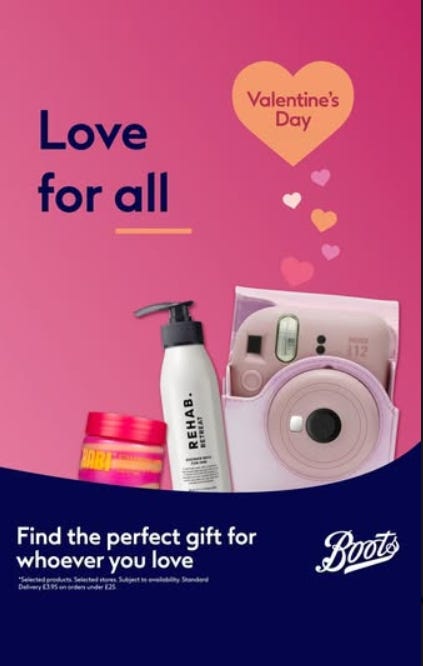
What Works:
This is a Stress-Relief Ad: Valentine’s gifting is pressure. This ad lowers it by saying “love for all,” which quietly removes the fear of picking the wrong thing for the wrong person.
They’re Selling Range, Not Products: The mix of items matters more than any single one. It signals “we’ve got something for everyone,” which is exactly what last-minute shoppers want to hear.
The Brand Plays Curator, Not Hero Boots steps back and lets the assortment shine. That positions them as the safe place to solve the problem, not the brand demanding attention.
When the moment is emotionally loaded, sell ease and coverage. People don’t want the “perfect” gift; they want to feel confident they won’t mess it up.
Advertise with Us
Wanna put out your message in front of over 50,000 best marketers and decision makers?
We are concerned about everything DTC and its winning strategies. If you liked what you read, why not join the 50k+ marketers from 13k+ DTC brands who have already subscribed? Just follow this.
At ScaleUP, we care about our readers and want to provide the best possible experience. That's why we always look for ways to improve our content and connect with our audience. If you'd like to stay in touch, be sure to follow us EVERYWHERE🥰
Thanks for your support :) We'll be back again with more such content 🥳