
Howdy Readers 🥰

In this newsletter, you’ll find:
🛒 Shop Now sends its own cart reminders. Here’s a four-week test diary
🔍 Google expands AI shopping and search links but keeps click data hidden
🏆 Ad of the day
If you’re new to ScaleUP then a hearty welcome to you. You’ve reached the right place along with 50k+ CEOs, CMOS, and marketers. Let’s get into it, shall we? Oh! Before you forget, if someone forwarded this newsletter to you, don't forget to subscribe to our newsletter so you never miss out!
Together with AirOps
Getting cited by AI is not the finish line. Getting chosen is.

Most teams now track citations like a rankings report. But a citation is a mention, and a mention does not build a pipeline.
Buyers use AI to research, shortlist, and decide, so the brands that win give them a reason to pick them.
Three recent AirOps Growth Leader webinars point to the same shift.
Kevin Indig’s data shows that ranking #1 for your key fan-out queries earns 58% of citations, four times more than rank #10.
Ross Simmonds found that Google’s AI surfaces lean on Reddit and YouTube, while the assistants favor off-site product and comparison pages.
Eli Schwartz’s point is that every asset still needs a conversion path.
Read the full takeaways to see where your content and off-site effort should go next.
🛒 Shop Now sends its own cart reminders. Here’s a four-week test diary
Shopify’s October 5 changelog made a quiet change to cart recovery. Shop can now verify who a shopper is while they browse, before any purchase. Carts sync across devices and between the Shop app and your storefront, and Shop reminds shoppers to finish carts they left behind.
Your abandoned-cart email may now land after a Shop nudge. Some recoveries you credit to your flow could be Shop’s, and the reverse.
Before Black Friday, find out what your flow adds on top. Here’s how the test could run, week by week.
Week 1: Baseline
Pull four weeks of data before the change:
Recovery rate: recovered orders divided by abandoned checkouts that had an email address
Revenue per recovery email sent
Share of orders paid with Shop Pay
Write the numbers down. You’ll compare against them in week four.
Week 2: Holdout
Split abandoned checkouts at random. Send 85% your normal flow and send nothing to the other 15%. That split is my judgment, big enough to read and small enough to protect revenue.
Say the flow group recovers 12% and the holdout recovers 7%. The 7% is what shoppers do on their own, Shop reminders included. Your flow’s real contribution is the 5-point gap.
If the holdout rate is much higher than last year’s recovery rate for people who got no email, Shop’s reminders are doing more of the work than before.
Week 3: Timing
If the gap shrank, your first email may be landing on top of Shop’s reminder. Test a first send at one hour against four hours on two random halves of the flow group.
Judge the winner by its gap over the holdout. Raw recovery rate can mislead here.
Week 4: Discounts
Check which email in the sequence produces the gap. If the lift only appears on the email with a discount, you’re paying for recoveries that might not need it.
Move the discount to the last email, and send it only to people who haven’t come back after the earlier messages.
Before the peak
Lock the winning timing by November 15. End the holdout by November 20, so every abandoned cart gets your flow during the busiest week. Restart a small holdout in January to see if the gap holds.
What to watch
Track Shop Pay’s share of orders weekly. If it climbs, more shoppers are inside Shop’s recognition and recovery loop, and your flow’s job shifts toward shoppers Shop doesn’t reach.
Your first move
Export last month’s abandoned checkouts and recoveries. You need that number before any reminder timing changes.
🔍 Google expands AI shopping and search links but keeps click data hidden
Google is introducing new shopping features, expanding links in AI-generated answers and testing deeper AI Mode integration, while publishers and marketers continue waiting for clearer traffic reporting.
The Breakdown:
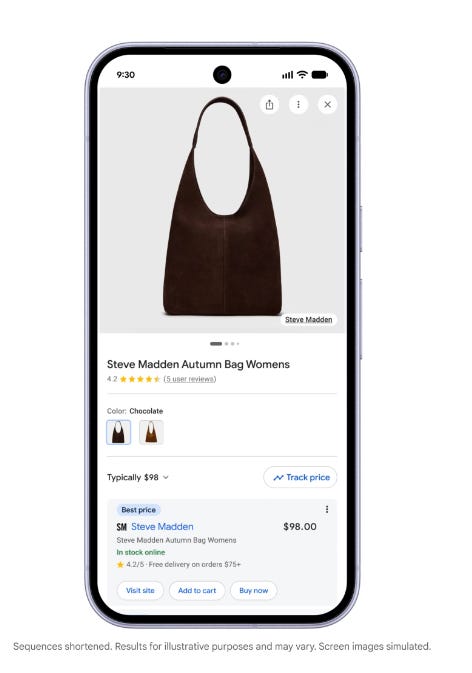
Google Introduces Universal Cart - Rolling out across Search and Gemini in the US, Universal Cart lets shoppers save products from multiple retailers, track price drops, receive restock alerts and access promotions. Participating retailers remain sellers of record.
AI Search Gets More Links - Google is adding more prominent inline links to AI Mode and AI Overviews. It is also testing dedicated sections highlighting one or two official websites for certain searches, potentially increasing visibility for authoritative sources.
Google Still Withholds AI Click Data - Despite expanding links, Google has not introduced separate click reporting for AI search experiences. Meanwhile, its News AI pilot now pays 400+ publications, including CNN, Axios and Forbes, for content used in AI summaries and audio briefings.
AI Mode Moves Into Regular Search - Google is testing an AI Mode chat sidebar within traditional search results, allowing users to move directly into conversational search. The experiment could increase searches completed without visiting external websites.
Google’s updates are keeping more of the shopping and search experience within its own ecosystem. While additional links may improve publisher visibility, limited click reporting makes their impact difficult to measure, leaving marketers increasingly dependent on their own referral and conversion data.
🏆 Ad of the Day
What Works:
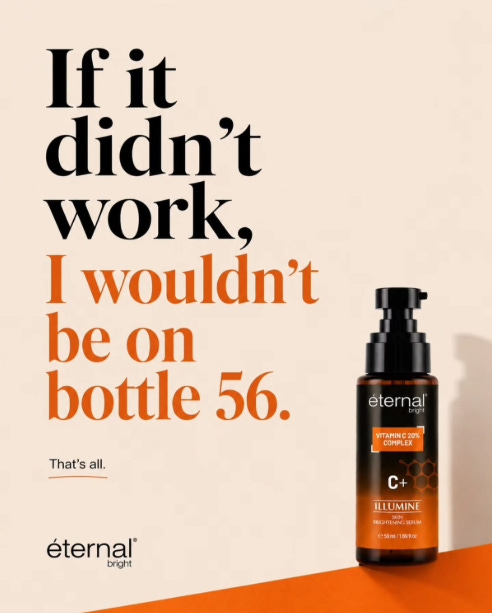
Contrarian Hook Wins - “If it didn’t work, I wouldn’t be on bottle 56” turns repeat purchase into the hook, creating strong social proof without needing a traditional testimonial format.
Repetition Signals Trust - “Bottle 56” implies long-term satisfaction and habitual use, giving the serum credibility through customer behavior rather than claims, while making the endorsement feel more believable.
Minimalism Builds Focus - The oversized typography, neutral background and isolated product keep cognitive load low, while the orange accent guides attention from the testimonial directly to the hero SKU.
Turn loyalty into proof by showing the exact number of bottles, orders or refills a customer has used. Specific repetition can feel more persuasive than generic praise.
Advertise with Us
Wanna put out your message in front of over 50,000 best marketers and decision makers?
We are concerned about everything DTC and its winning strategies. If you liked what you read, why not join the 50k+ marketers from 13k+ DTC brands who have already subscribed? Just follow this.
At ScaleUP, we care about our readers and want to provide the best possible experience. That's why we always look for ways to improve our content and connect with our audience. If you'd like to stay in touch, be sure to follow us EVERYWHERE🥰
Thanks for your support :) We'll be back again with more such content 🥳