
Howdy Readers 🥰

In this newsletter, you’ll find:
🔎 Search demand is now divided
📊 AI is reshaping ads, shopping and search measurement
🏆 Ad of the day
If you’re new to ScaleUP then a hearty welcome to you. You’ve reached the right place along with 50k+ CEOs, CMOS, and marketers. Let’s get into it, shall we? Oh! Before you forget, if someone forwarded this newsletter to you, don't forget to subscribe to our newsletter so you never miss out!
🔎 Search demand is now divided
A study released this month analyzed more than one million high-volume keywords across 379 brands in eight industries.
The headline number says 29% of tracked search volume is declining, but that isn’t the real story. Roughly the same amount of demand is growing elsewhere, leaving overall search demand broadly stable. What’s changing is where that demand sits, and the dividing line is how completely AI can answer the query without sending someone anywhere else.
The split isn’t between good and bad keywords
It’s between answerable queries and decision-making queries.

The first category includes searches where a chatbot can satisfy the user’s need immediately, such as explaining a tax deduction or summarizing an investment fund. Those areas are declining the fastest, with FinTech down 37.7%.
The second category still requires judgment. Comparing products, evaluating alternatives or deciding what to buy pushes people beyond a single AI response, which is why categories like Lifestyle, down 15.2%, are holding up much better.
Each bucket rewards a different content strategy
For fully answerable queries, the objective is no longer maximizing clicks. It’s becoming the passage AI chooses to quote.
That means putting the answer near the top of the page, writing it as a complete, self-contained explanation and avoiding long introductions or unnecessary SEO filler that separates the question from the answer.
Comparison and purchase keywords need almost the opposite treatment. Visitors still want pricing, feature comparisons, trade-offs and proof before making a decision, so those pages should focus on helping someone evaluate options rather than simply answering a question.
Applying the same content template to both categories usually underperforms because each serves a different type of search behaviour.
Audit your keyword portfolio before changing your strategy
Industry averages only reveal the direction of travel.
The more useful exercise is reviewing your own keyword set and separating informational searches from comparison and buying-intent searches before deciding what success should look like for each.
Semrush’s AI Visibility Toolkit combines traditional keyword tracking with AI mentions and citations across ChatGPT, Perplexity, Gemini and Google’s AI experiences, making it possible to see which keywords are competing for citations and which are still competing for clicks. You can try it for free for 7 days.
Search demand hasn’t disappeared. It’s split into two different games, and brands still using one strategy for both are usually losing ground in each.
📊 AI is reshaping ads, shopping and search measurement
OpenAI is rapidly building ChatGPT into a performance advertising platform, while Google is bringing generative AI deeper into both Shopping ads and conversational search measurement.

The Breakdown:
1. ChatGPT Ads targets conversions - ChatGPT Ads now supports oCPC product-feed campaigns, dynamic URL parameters, bulk CPC migration, and multi-product carousel testing, giving ecommerce advertisers more tools to optimize directly toward conversions.
2. OpenAI strengthens measurement - Triple Whale, Hightouch, and Sonar Optimize integrations improve attribution and conversion signals. Pixel diagnostics are expanding, while Automatic Advanced Matching becomes default for new pixels and existing ones from August 17.
3. ChatGPT leads, Gemini accelerates - ChatGPT remains preferred by 33.7% of recent U.S. generative AI users versus Gemini’s 18.2%, but Gemini gained 6.8 percentage points while ChatGPT declined 5.9 points.
4. Google experiments across ads and search - Google is testing AI-generated Shopping ad descriptions. Search Console also records AI Mode follow-ups like “Yes“ as new queries, giving conversational searches separate impressions, clicks, and positions.
AI is moving beyond answering questions into the commercial infrastructure around discovery. Advertising, optimization, attribution, creative generation, and even the definition of a search query are changing together.
🏆 Ad of the Day
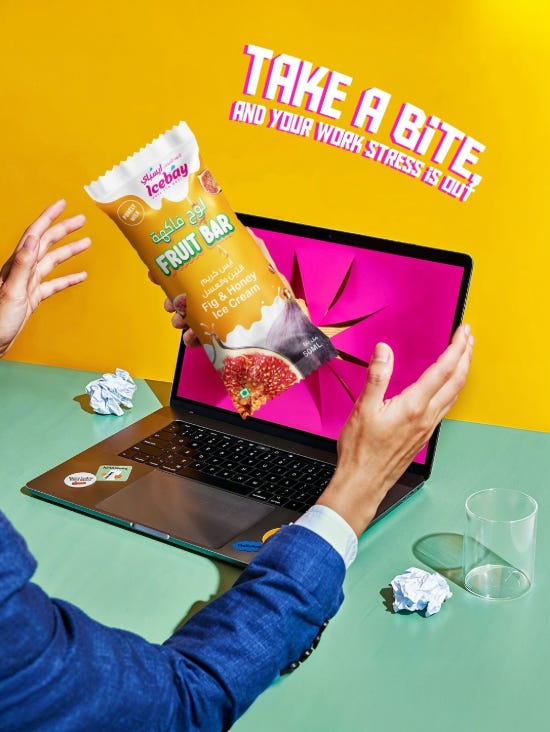
What Works:
Context Makes Relevant - Placing the snack directly into a stressful work scene gives the product an immediate consumption occasion, strengthening message-market fit and making the creative feel behaviorally grounded.
Color Stops Scroll - The yellow, pink and mint palette creates a loud pattern interrupt, while the oversized floating pack keeps visual hierarchy focused on the product despite the busy scene.
Hook Connects Emotion - “Take a bite, and your work stress is out” links the product to emotional relief, giving the snack a stronger role than taste alone and improving memorability.
Build creatives around high-friction daily moments like work stress, commuting or deadlines, then position the product as the immediate reward that breaks that tension.
Advertise with Us
Wanna put out your message in front of over 50,000 best marketers and decision makers?
We are concerned about everything DTC and its winning strategies. If you liked what you read, why not join the 50k+ marketers from 13k+ DTC brands who have already subscribed? Just follow this.
At ScaleUP, we care about our readers and want to provide the best possible experience. That's why we always look for ways to improve our content and connect with our audience. If you'd like to stay in touch, be sure to follow us EVERYWHERE🥰
Thanks for your support :) We'll be back again with more such content 🥳