
Howdy Readers 🥰
In this newsletter, you’ll find:
😤Price is a design variable
📊 Meta Dropped Below 50% Budget Share, And the Platforms Absorbing That Spend Aren’t Earning It
🏆 Ad of the Day
If you’re new to ScaleUP then a hearty welcome to you. You’ve reached the right place along with 50k+ CEOs, CMOS, and marketers. Let’s get into it, shall we? Oh! Before you forget, if someone forwarded this newsletter to you, don't forget to subscribe to our newsletter so you never miss out!
😤Price is a design variable
Neuroscience on purchasing shows the brain registers spending money as a genuine small pain, and how sharply a price is presented changes how intensely that pain registers. The number does not have to change for the discomfort to.
Most teams treat price as fixed once the figure is set. The presentation around that figure is a separate lever, and it is almost entirely untested in most stores.
Reduce the visual weight of the moment of payment. Every explicit currency symbol, every bold price treatment, every reminder that a transaction is occurring nudges a browsing shopper toward budget-defense mode.
Audit your product and checkout pages for how many times money is visually emphasized versus simply stated.
Test a lighter treatment on one page: smaller font weight on the price, less currency signage repeated across the page, price shown once clearly rather than restated at every step.
Run it as a genuine A/B split, not a full rollout, since under-signaling price at checkout can backfire by creating surprise at the final total.
Separate the decision to want the product from the decision to pay for it. Add-to-cart should feel like collecting, not committing. Delay the strongest price signaling until checkout itself, where the shopper has already decided and needs clarity, not persuasion.
Test moving price emphasis: minimal on the product grid, moderate on the product page, fully explicit only at cart and checkout.
The goal is matching the intensity of the reminder to the stage where the shopper is actually deciding to spend.
Test friction removal with the same rigor as a landing page redesign. A one-symbol change or a font-weight adjustment sounds too small to matter, which is exactly why almost nobody tests it and why the ones who do often find outsized returns relative to the effort.
Run these as proper statistically powered tests against your existing baseline, not as a permanent swap based on instinct, and measure against revenue per visitor rather than conversion rate alone, since friction changes often shift order value more than they shift the decision to buy at all.
The pattern across all three: painful moments in a purchase are not fixed facts about your pricing. They are design decisions hiding inside pages nobody has audited for exactly this.
📊 Meta Dropped Below 50% Budget Share, And the Platforms Absorbing That Spend Aren’t Earning It
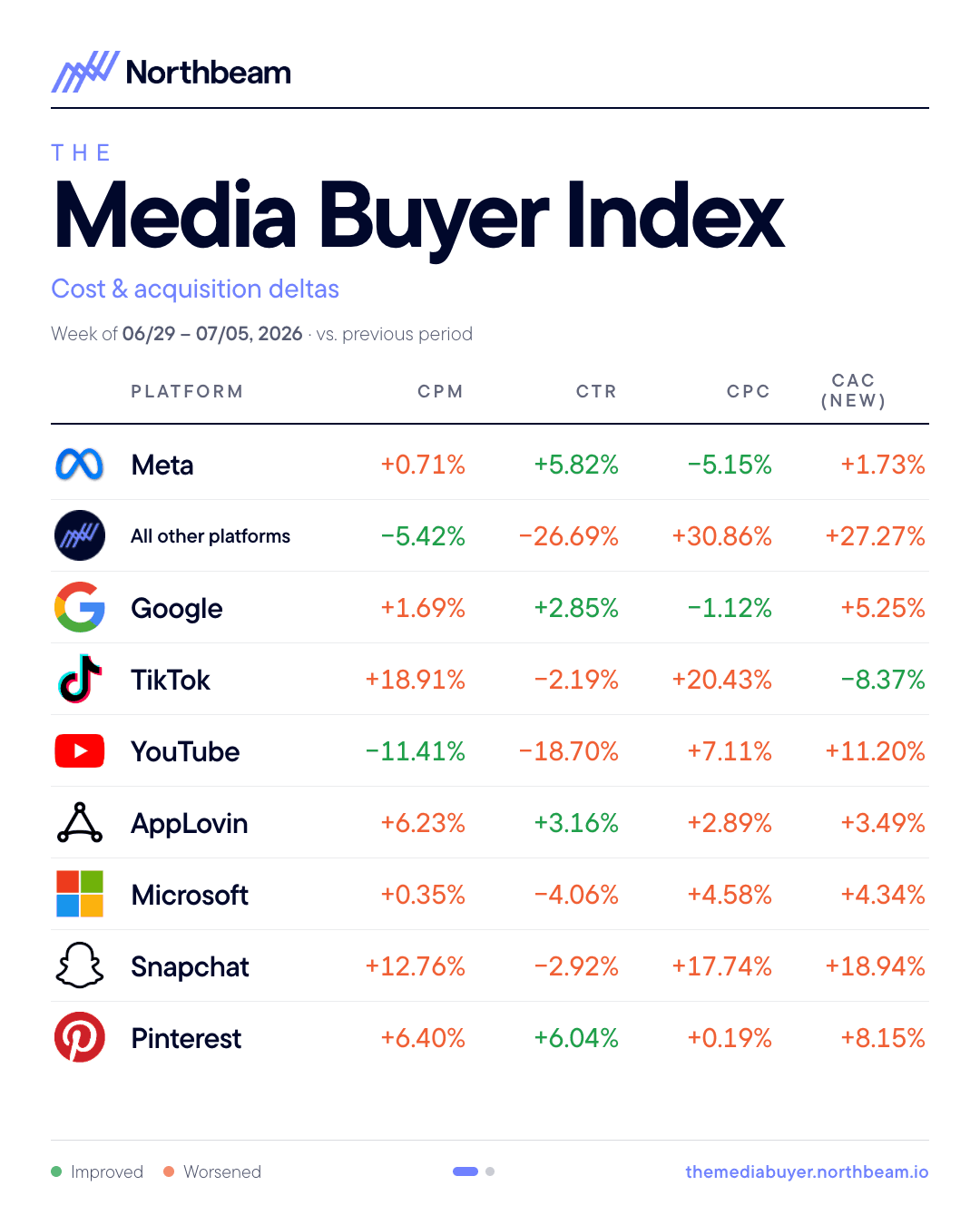
Last week’s environment shifted at the portfolio level, Meta shed meaningful share for the first time in months while CAC deteriorated broadly across high-visibility platforms, forcing a harder look at where reallocated budget is actually landing and whether it’s justified.
The Breakdown:
CPC - Meta and Google saw click costs fall while TikTok, Snapchat, and YouTube pushed higher, where CPCs rose sharply alongside CAC deterioration like YouTube and Snapchat, reduce spend now and wait for costs to stabilize before re-entering at scale.
CAC - TikTok improved strongly while Meta, Google, YouTube, Snapchat, and Pinterest all worsened, TikTok’s CAC improvement despite rising CPCs signals genuine conversion strength; run a controlled budget increase there and monitor whether the efficiency holds above current spend levels.
ROAS - Microsoft led at +18.92% while YouTube (-16.41%), Snapchat (-18.25%), and AppLovin (-7.46%) all collapsed, Microsoft at 0.89% budget share posting the week’s strongest ROAS is a clear underfunding signal; move a test budget in this week before the auction catches up.
Meta fell below 50% share to 49.13% while YouTube, Snapchat, and AppLovin absorbed budget they didn’t earn, all three posted negative ROAS and deteriorating CAC simultaneously.
Redirect that freed spend into Microsoft where ROAS hit +18.92%, and treat TikTok’s +27.72% CvR as the clearest conversion signal on the board, it deserves more budget, not less, heading into next week.
🏆 Ad of the Day
What Works:
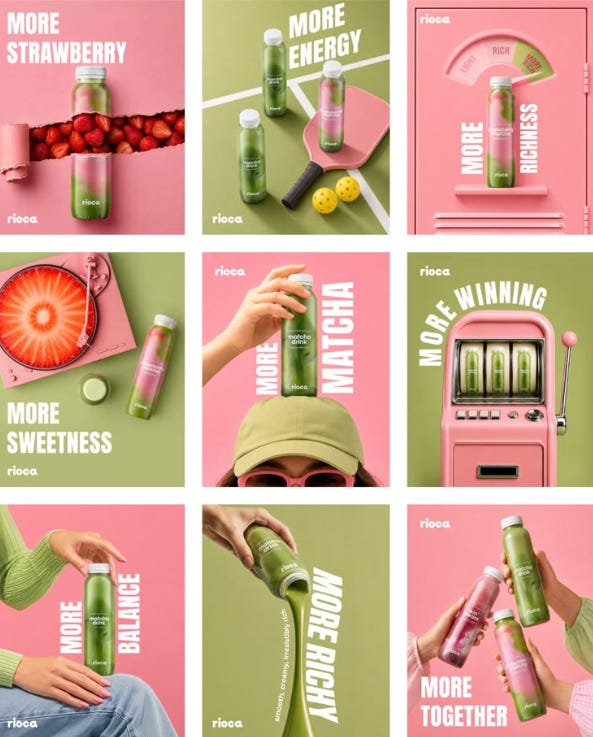
Campaign Consistency - Every post follows the same visual system while changing only one core message. This builds instant brand recognition without making the feed feel repetitive or monotonous.
One Benefit Focus - Each creative owns a single “More...” benefit like energy, sweetness, richness, or balance. Narrow messaging is easier to remember than trying to communicate every product advantage at once.
Color Owns Identity - The consistent pink and green palette becomes a brand asset rather than decoration. Even without a logo, frequent viewers can recognize the brand from its colors alone.
Create repeatable design templates where layouts, colors, and typography remain consistent while only the headline and visual concept change. Recognition compounds across every campaign, lowering creative fatigue and strengthening brand recall.
Advertise with Us
Wanna put out your message in front of over 50,000 best marketers and decision makers?
We are concerned about everything DTC and its winning strategies. If you liked what you read, why not join the 50k+ marketers from 13k+ DTC brands who have already subscribed? Just follow this.
At ScaleUP, we care about our readers and want to provide the best possible experience. That's why we always look for ways to improve our content and connect with our audience. If you'd like to stay in touch, be sure to follow us EVERYWHERE🥰
Thanks for your support :) We'll be back again with more such content 🥳