
Howdy Readers 🥰
In this newsletter, you’ll find:
😁 Hooks don’t convert, answers do
📲 Facebook Feed Overhaul + YouTube Shorts Recency Shift
🏆 Ad of the Day
If you’re new to ScaleUP then a hearty welcome to you, you’ve reached the right place along with 50k+ CEOs, CMOS, and marketers. Let’s get into it, shall we? Oh! Before you forget, if someone forwarded this newsletter to you, don't forget to subscribe to our newsletter so you never miss out!
Together with Lindy
Give Your Marketing Team Superpowers with AI Agents

Stop grinding through marketing tasks.
Lindy AI CMO agents analyze competitors, write strategy docs, create campaign briefs, and generate assets, all organized in Airtable. Your 24/7 marketing team that ships campaigns fast.
See AI Agents in Action today!
😁 Hooks don’t convert, answers do
Reel viewers are not there to be convinced. They are there to run a fast internal test: is this worth another second, and is it safe to believe?
The thumb is not rejecting products; it is rejecting uncertainty, which is why Meta’s research-backed guidance focuses on purchase intent structure, not “virality.”
Start with the ending, not the hook
Most teams start loud and hope the rest holds. A stronger approach is picking the one doubt that must be removed, then building backward.Pick one doubt per Reel.
Will it work for someone like me?Will I actually use it?Is it worth the price?Will the results show up fast? Is this premium or gimmicky?
The Proof Stack sequence, backed by the research points
1) Context beyond the hook
Adding context after the initial grab is one of the strongest drivers of purchase intent in Meta’s guidance. In practice, this is one tight proof point, USP, or mechanism hint, not a list.
2) Product appears early, then returns
Showing the product multiple times, across angles and use cases, increases the odds of landing in top purchase intent performance cohorts.
Each reappearance functions like another “receipt” the brain can trust.
3) Brand integration as a whisper
Brand presence can lift performance, but only if it stays under a limited share of the video; otherwise, results drop.
Treat the brand like a signature, packaging in hand, subtle logo, natural spoken mention, not a takeover.
4) Two-channel CTA
Using both a visual CTA and an audio CTA outperforms relying on only one channel. Say it and show it to reduce cognitive load in a swipe environment.
5) Speech plus music
The speech and music combo outperforms pure music or pure voiceover. Music carries energy, speech carries intent.
6) Native elements beat studio polish
Platform-native cues like emojis correlate with stronger performance than overly polished studio creatives because they match what Reels users already consume.
The scalable brief
Brief Reels by proof type, not angles. Usage proof, results proof, routine-fit proof, premium-quality proof, social proof. Same Proof Stack, different proof, and if you need to produce that proof across many creator faces quickly, without losing consistency.
Insense is a practical way to source creators and collect modular UGC clips you can plug into each proof type. You can book a free strategy call by December 12th and get $200 for your first campaign!
Three tests to run now
3 to 5 scene product showcases. Light brand presence around 15 to 25% of the duration. Dual-layer messaging with on-screen text plus voice CTA.
📲 Facebook Feed Overhaul + YouTube Shorts Recency Shift
Facebook and YouTube just made major discovery changes. Facebook is redesigning the feed for immersion and control, while YouTube may be quietly deprioritizing Shorts older than 30 days.
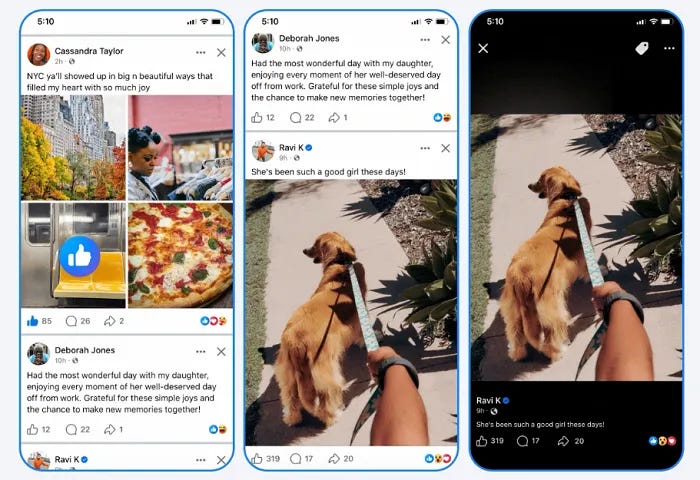
1. Facebook goes simpler, more visual, and full-screen: Multi-photo posts now auto-grid, support double-tap likes, and expand to full screen on tap. Search now shows an immersive grid, with a new full-screen viewer rolling out soon.
2. Facebook introduces deeper algorithm control and IG-style posting: Tapping X on a post now opens new topic-level refinement tools so users can signal what they want more or less of. It is also highlighting top editing tools in the composer to encourage richer, Instagram-like posts.
3. YouTube Shorts may now boost fresh over evergreen: Analysts working with large channels report Shorts older than 28–30 days lost impressions sharply starting mid-September.
Retention strategist Mario Joos calls this “the flattening,” suggesting YouTube is rewarding frequent uploads. Multiple creators confirm drops, warning that this kills long-tail value and pushes quantity over quality.
Why it matters
Facebook is trying to revive engagement with immersion, controls, and interest-based discovery, while YouTube may be shifting to a freshness-driven Shorts algorithm. The result: faster content cycles, less evergreen stability, and more pressure on consistent publishing.
🎥 Ad of the Day

What Works:
1) “Romanticize” reframes consumption as self-authorship - That verb taps into a cultural script where ordinary life becomes intentional and aesthetic, not just routine. It turns buying into identity editing, making the product feel like a tool for mood design. When the promise is “upgrade the moment,” price becomes secondary to meaning.
2) The word “RITUAL” behaves like a permission slip - Ritual implies consistency, comfort, and a repeatable emotional payoff, which quietly primes habitual purchasing. It also elevates drinking from “having something” to “doing something,” which feels more wholesome and socially shareable. Naming the behavior is how you manufacture the category.
3) Friendship intimacy is the real product - The laughter, eye contact, relaxed posture, and home setting trigger belonging and safety, two of the strongest drivers of indulgent purchases. When you sell a social feeling, the SKU becomes the ticket.
Advertise with Us
Wanna put out your message in front of over 50,000 best marketers and decision makers?
We are concerned about everything DTC and its winning strategies. If you liked what you read, why not join the 50k+ marketers from 13k+ DTC brands who have already subscribed? Just follow this.
At ScaleUP, we care about our readers and want to provide the best possible experience. That's why we always look for ways to improve our content and connect with our audience. If you'd like to stay in touch, be sure to follow us EVERYWHERE🥰
Thanks for your support :) We'll be back again with more such content 🥳
Solid breakdown of why starting from doubt removal outperforms attention-grabbing. The Proof Stack structure makes alot of sense, specially the part about product reapperance functioning as multiple trust signals. Most creators front-load one big proof momment when they should be layering smaller proofs throughout the whole thing.