
Howdy Readers 🥰
In this newsletter, you’ll find:
👀 The reason your content isn’t getting cited by AI has nothing to do with your content.
📊 Snapchat quietly became the most efficient channel this week, and almost no one is allocated there
🏆 Ad of the Day
If you’re new to ScaleUP then a hearty welcome to you. You’ve reached the right place along with 50k+ CEOs, CMOS, and marketers. Let’s get into it, shall we? Oh! Before you forget, if someone forwarded this newsletter to you, don't forget to subscribe to our newsletter so you never miss out!
👀 The reason your content isn’t getting cited by AI has nothing to do with your content.
Google just confirmed that AI search features are governed by the same crawl and indexing systems as traditional search.
If an AI crawler can’t access your site, no amount of content optimization moves the needle.
Most sites are blocking at least one AI crawler right now. Not intentionally. Through CDN configurations and WAF rules set up years ago that nobody has revisited since AI crawlers became citation sources.
Here’s how to find it and fix it.
1. Audit your robots.txt for AI crawler user agents
Standard SEO audits check Googlebot. Almost none check the four AI crawler user agents that determine your AI visibility ceiling:
ChatGPT-User
OAI-SearchBot
Perplexity-User
Claude-SearchBot
Open your robots.txt and search for each string. A disallow rule on any of them is a hard cap on that platform’s citation visibility, regardless of content quality, entity signals, or anything else you’ve optimized.
Find a block? Remove it and resubmit through Google Search Console. Then go deeper.
2. Check server logs for AI crawler rejections
Robots.txt is only one layer. CDN and WAF configurations block AI crawlers at the infrastructure level, returning 403 or 429 responses that never surface in standard SEO reporting.
Pull your server logs. Filter for requests from each AI crawler user agent. Look for:
403, infrastructure actively rejecting the crawler
429, rate-limiting it to the point of ineffectiveness
This is where the real problem lives. A robots.txt block is visible. An infrastructure block is invisible until you specifically look for it.
Once your pages are confirmed crawlable, track whether citation rates respond. *SEMrush’s AI Visibility Toolkit shows your visibility across ChatGPT and Google AI Mode so you can connect crawler fixes to actual citation movement. You can try it free for 7 days.
3. Set a quarterly AI crawler audit
CDN and WAF rules change with infrastructure updates. A routine deployment can silently reintroduce blocking without triggering a single SEO alert.
Every quarter: recheck server logs for AI crawler response codes across every site you manage. Under 30 minutes. Catches the problem most likely to silently undo citation progress already built.
Google confirmed the foundation. Crawler access is the foundation. Everything else only works if this layer is clean.
📊 Snapchat Quietly Became the Most Efficient Channel This Week, And Almost No One Is Allocated There
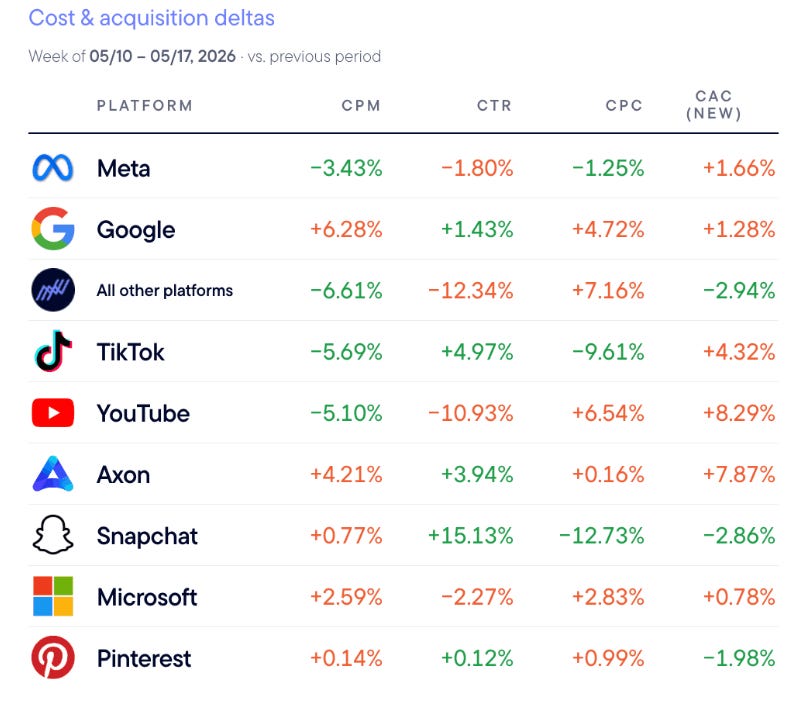
Last week’s signals were messy at the surface, but coherent underneath. Costs and returns moved in opposite directions across most major platforms, and the channels holding the clearest efficiency story are the ones receiving the least budget attention.
The Breakdown:
CPC - Meta and TikTok saw click costs fall while Google and YouTube pushed higher. CPC dropped, but CAC worsened; like TikTok and YouTube, don’t treat cheaper clicks as a green light; tighten audience segments first.
CAC - Snapchat, Pinterest, and “all other platforms” improved while YouTube, TikTok, Axon, and Google worsened. Platforms improving CAC deserve incremental budget tests at controlled spend levels to confirm whether gains hold before committing to a full shift.
ROAS - Snapchat led at +5.88%, and Axon posted +3.04% while Pinterest collapsed at -7.76% and Meta slipped -2.53%, rotate creative attention toward Snapchat and Axon this week, and hold Pinterest spend flat until ROAS stabilizes.
Meta holds 52.37% share and Google 19.68%, over 70% combined, while Snapchat at 0.96% is posting the week’s best ROAS with improving CAC. Move a test budget into Snapchat now, reduce exposure on Pinterest and Meta where both ROAS and CvR are declining, and don’t let share inertia drive next week’s allocation.
🏆 Ad of the Day

What Works:
Emotional Substitution: The dessert serves as a stand-in for effort and affection. Consumers subconsciously read the product as a relationship-building tool rather than a snack purchase.
Social Utility - The product gains gifting utility here. Consumers now mentally categorize it for dates, apologies, celebrations, and mood-repair moments instead of everyday consumption only.
Scenario Marketing - Instead of promoting flavors, the ad sells a moment that people already emotionally recognize. That dramatically improves memorability compared to generic food photography.
Attach your product to emotionally charged social situations that consumers already experience repeatedly. Ritual-based positioning often outperforms feature-based food marketing because it creates behavioral relevance.
*When you purchase through links in this article, we may earn an affiliate commission from Semrush.
Advertise with Us
Wanna put out your message in front of over 50,000 best marketers and decision makers?
We are concerned about everything DTC and its winning strategies. If you liked what you read, why not join the 50k+ marketers from 13k+ DTC brands who have already subscribed? Just follow this.
At ScaleUP, we care about our readers and want to provide the best possible experience. That's why we always look for ways to improve our content and connect with our audience. If you'd like to stay in touch, be sure to follow us EVERYWHERE🥰
Thanks for your support :) We'll be back again with more such content 🥳