
Howdy Readers 🥰
In this newsletter, you’ll find:
💰 Five steps to a ChatGPT ads test your finance team will approve and believe
📊 ChatGPT gets new business tools as AI search changes how brands get discovered
🏆 Ad of the Day
If you’re new to ScaleUP then a hearty welcome to you. You’ve reached the right place along with 50k+ CEOs, CMOS, and marketers. Let’s get into it, shall we? Oh! Before you forget, if someone forwarded this newsletter to you, don't forget to subscribe to our newsletter so you never miss out!
Together with New Engen
Your January Ads Should Be in Production Now

If your Meta account has stalled, another month of the same creative gives you little new to work with.
Grapevine, now part of New Engen, produces creator ads you can run through creators’ accounts, with production handled for you.
Approve angles and ship product. Grapevine books and pays creators, writes briefs, and edits in-house.
Get fresh creative in under 30 days from kickoff, giving you time to test before January.
Start with flexible pricing and no minimum spend, then test month to month before committing further.
Futurhealth runs over 40% of its account on Grapevine assets and improved CPA by more than 15%. To budget for your own test, check your cost per asset in the fee calculator.
Kick off by November 30 and your first campaign is free: 8 statics and 1 article worth $1,500. Head into Q1 with fresh creative ready to put to work.
💰 Five steps to a ChatGPT ads test your finance team will approve and believe
Q1 budgets are being set now. The person proposing a ChatGPT ads test will hear two questions: what will it cost, and how will we know it worked? Here’s what’s known, per PPC.io’s October 17 guide. Bidding is CPM or CPC.
OpenAI publishes no rate card or minimum. Third-party guides quote $25 to $60 CPM. Reporting is aggregate, and OpenAI points advertisers to geo tests with partners such as Haus, Measured, and WorkMagic to prove lift.
Step 1: Price a click three ways
At a $25 CPM, a 0.6% click-through rate means about $4.17 a click, 1% means $2.50, and 2% means $1.25. The 0.6% figure is the one named advertiser result in that guide. Plan on the middle and show the range.
Step 2: Size the spend
Say you need 40 purchases to judge the channel, and paid visitors convert at 2%. That’s 2,000 clicks: $5,000 at $2.50, about $8,340 at $4.17. Illustrative, so swap in your conversion rate.
Step 3: Design the holdout
Platform-reported conversions can’t prove the ads caused sales. A geo test can. Split comparable regions into two groups with similar sales over the last eight weeks. Run ads in one group only, for four weeks. Ask a measurement partner to set it up, or check whether your account can restrict delivery by region.
Then do the math. Before the test, test regions sold 1.0 times what holdout regions sold. During it, test regions sell 1,150 orders and holdout regions 1,000. Incremental orders: 1,150 minus 1,000 = 150. On $6,000 of spend, that’s $40 per incremental order. If the platform reported 220 conversions, 70 would have happened anyway. All numbers are illustrative.
Step 4: Set the bar and show the evidence
Agree in writing before launch: an incremental cost per new customer within 20% of paid search means expand. That threshold is my judgment.
Then show why your angle is worth testing. The AirOps ChatGPT Ad Library lists 6,000+ brands. Search competitors by brand name or domain to see their ad messaging, then explore the prompts where those ads appeared. Two or three real examples next to your angle answer “why this test” before anyone asks. You can explore the ChatGPT Ad Library here.
Step 5: Write the one-page memo
Angle, budget range, holdout design, success bar, competitor examples, and a four-week timeline with no mid-test edits.
Today
Pull your paid search cost per new customer and weekly sales by region for the last eight weeks. The memo and the holdout both start there.
📊 ChatGPT gets new business tools as AI search changes how brands get discovered
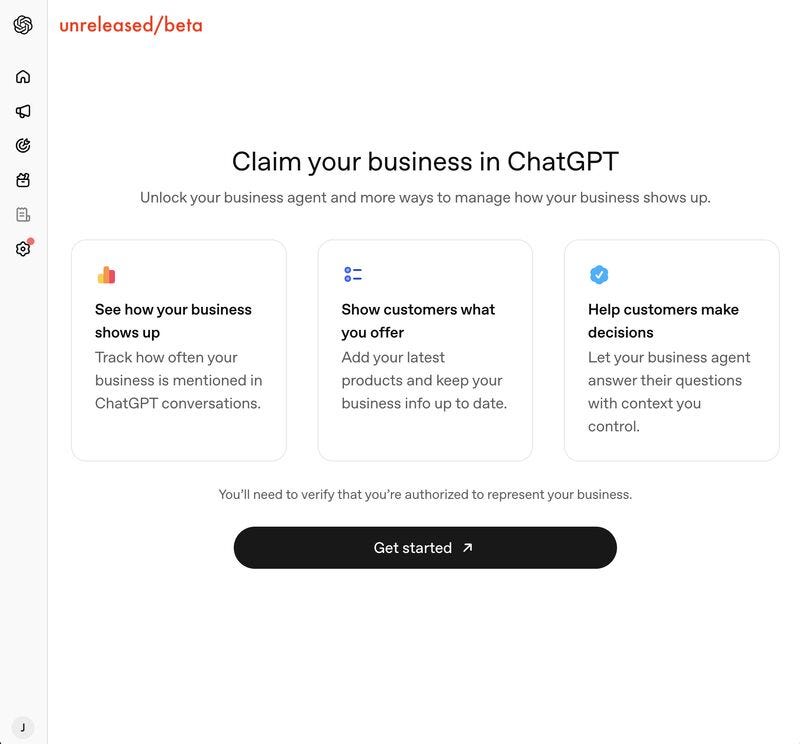
OpenAI is working on new ways for businesses to track their presence in ChatGPT and manage advertising costs, while developments in AI crawling and content optimization are changing how websites get discovered and used by AI assistants.
The Breakdown:
OpenAI is testing a Business Hub that shows how often brands appear in ChatGPT answers and how many website clicks they receive, with options to update business details and answer customer questions through AI agents.
ChatGPT Ads now lets advertisers set a target cost per conversion or click, with AI automatically adjusting bids toward those goals. The older Max Bid and Max CPC options will be discontinued on January 1, 2027.
OpenAI is paying Cloudflare to identify when websites update their content, helping its crawler avoid unnecessary visits. Meanwhile, Brave faces lawsuits over selling website data to AI companies without a separate crawler opt-out.
A study of 15 YouTube videos found that better-structured descriptions increased AI retrievals by 359%, compared with 17% for unchanged videos, although the study couldn’t confirm that descriptions alone caused the increase.
Businesses are getting more ways to measure and improve how they appear in AI-generated answers. From tracking ChatGPT mentions to making existing content easier for AI to find, these developments could help marketers understand where their visibility comes from and how to improve it.
🏆 Ad of the Day

What Works:
Skin Sells Outcome - The close-up face makes glow the hero benefit before shoppers even read the copy, turning the model’s skin into visual proof and strengthening product desirability.
Offer Feels Immediate - “15% off your first order” plus “this week only” combines acquisition incentive with urgency, giving first-time shoppers a clear reason to convert now.
CTA Closes Cleanly - The large “Shop the serum” button sits directly beneath the product and face, creating strong CTA clarity while keeping the conversion path simple on mobile.
For skincare, let the model’s skin demonstrate the promise, then support it with one focused product, one offer and one unmistakable CTA.
💃Events
🔥 How to Show What Your AI Search Budget Actually Bought
November 20 | 2 PM ET | Virtual Event
Google Meridian creator Hitesh Wadhwani and AirOps COO Matt Hammel break down how to quantify AI search exposure, distinguish recommendations from simple mentions, and bring that signal into marketing mix models. Leave with the exact measurement gaps to fix before your next budget review.
Can’t attend the session live? Register anyway, and you’ll get the recordings in 24 hours.
Advertise with Us
Wanna put out your message in front of over 50,000 best marketers and decision makers?
We are concerned about everything DTC and its winning strategies. If you liked what you read, why not join the 50k+ marketers from 13k+ DTC brands who have already subscribed? Just follow this.
At ScaleUP, we care about our readers and want to provide the best possible experience. That's why we always look for ways to improve our content and connect with our audience. If you'd like to stay in touch, be sure to follow us EVERYWHERE🥰
Thanks for your support :) We'll be back again with more such content 🥳