
Howdy Readers 🥰
In this newsletter, you’ll find:
📈 Free Shipping Is Paying for Chaos
🤖 AI Took Over Holiday Customer Service
🏆 Ad of the Day
If you’re new to ScaleUP then a hearty welcome to you, you’ve reached the right place along with 50k+ CEOs, CMOS, and marketers. Let’s get into it, shall we? Oh! Before you forget, if someone forwarded this newsletter to you, don't forget to subscribe to our newsletter so you never miss out!
Together with Levanta
Modern Shoppers Buy Everywhere. Your Affiliate Program Should Too

If your affiliate program only lives on your DTC site, it’s built for 2010. Today, customers research on Amazon, compare on Walmart, and purchase wherever it’s convenient.
When programs don’t follow that behavior, visibility suffers, making it harder to see what’s driving revenue and what to scale next.
Levanta helps modern e-commerce brands run affiliate and creator partnerships across multiple marketplaces as a single, measurable performance channel.
With Levanta, sellers can:
Partner with 50,000+ vetted creators and affiliates
Track clicks, sales, and ROI with clear analytics
Amplify what works and stop paying for what doesn’t
Manage creators, commissions, and payouts across marketplaces with ease
Qualified sellers who book a demo will receive a $75 Uber Eats or DoorDash gift card. Eligibility confirmed after booking.
📈 Free Shipping Is Paying for Chaos
Checkout friction is rarely accidental.
Free shipping thresholds creep upward. Bundles become mandatory. Surprise shipping fees appear late in the flow. The explanation is always framed as a strategy. Increase AOV. Protect margins. Encourage better carts.
But underneath, friction is often doing a different job.
It is compensating for fulfillment inefficiency.
When fulfillment costs are unpredictable, checkout becomes the pressure valve.
Instead of fixing routing logic, inventory placement, or carrier selection, brands raise thresholds to absorb the variance. Instead of tightening delivery promises, they blur them. The cart becomes the place where economics get corrected.
Customers feel this immediately.
They hesitate. They abandon. They sense the mismatch between confidence before checkout and uncertainty during it. Conversion drops, and the diagnosis follows a familiar path. Traffic quality. Creative fatigue. Offer weakness.
Rarely does anyone look downstream.
High free-shipping thresholds don’t just reduce conversion. They distort behavior.
Customers add items they don’t want. They delay purchases, waiting to justify the cart. They mentally reframe the brand as expensive or inconvenient. What was meant to improve unit economics quietly damages trust and long-term value.
This is why checkout optimization and fulfillment optimization cannot be separated.
When fulfillment economics are unstable, checkout friction becomes a blunt instrument.
This pattern shows up clearly when fulfillment is examined side by side.
Shipfusion ordered from five leading clear protein brands within the same hour. What differed wasn’t pricing or product positioning. It was how fulfillment decisions surfaced at checkout.
Brands with predictable routing and tighter delivery control could set clearer expectations without padding thresholds. Others relied on higher free-shipping minimums while still delivering inconsistent experiences, including one order that traveled over 2,000 miles farther than necessary.
The friction wasn’t strategic. It was defensive.
Clear protein was just the test case, but the same problems show up across every DTC brand that ships. If you ship physical products, you need to see this.
If you want to see where checkout rules are masking fulfillment inefficiencies. You can download your DTC Delivery Files here.
Checkout should not exist to protect operations. It should exist to clarify value.
When fulfillment is designed efficiently upstream, checkout can stay simple, confident, and honest. Thresholds can align with intent instead of fear. Conversion improves without sacrificing margin.
The brands that scale cleanly don’t use friction to fix economics. They fix economics so friction isn’t needed. That distinction determines whether checkout accelerates growth or quietly slows it down.
🤖 AI Took Over Holiday Customer Service
The 2025 holiday season became a turning point for AI in retail service. Most shoppers encountered automation in some form, and many felt it more strongly than ever before. Speed improved, but satisfaction told a more nuanced story.
The Breakdown:
1. AI adoption reached a tipping point - Around 78% of shoppers interacted with AI during holiday shopping, with 73% noticing a year-over-year increase. Automation showed up most in chat, website help, delivery tracking, and returns.
AI delivered clearly on efficiency, as 85% of consumers reported faster service and easier access. Many appreciated 24/7 availability and quicker answers, especially during peak shopping pressure.
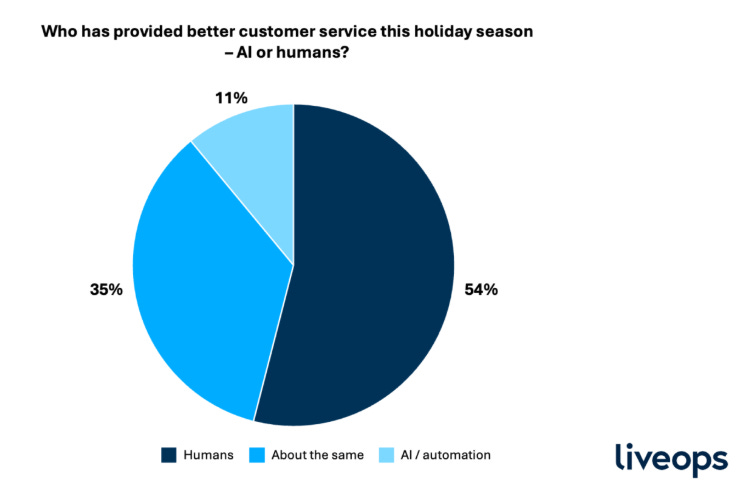
2. Human escalation remains essential - Even with efficiency gains, 54% of shoppers said humans provided better service than AI. Over half had to escalate AI-handled issues, showing that empathy and judgment still make a difference.
Only 22% of shoppers said brands clearly disclosed AI usage, even though 69% believe disclosure should always happen.
Shoppers aren’t rejecting AI, they’re rejecting bad AI. The signal for 2026 is clear: prioritize quality over quantity, use AI for speed not empathy, disclose it transparently, personalize by generation, and treat AI as a support layer for humans, not a replacement.
🏆 Ad of the Day

1. Problem-aware - It’s for people who feel conversations have gotten shallow but haven’t actively searched for a “connection” product yet.
2. Emotional aspiration - It taps into the quiet desire for deeper relationships without making it sound heavy, awkward, or therapy-adjacent.
3. Warm-up and desire creation - This ad isn’t pushing urgency; it’s planting the idea that depth can be structured and easy.
When you’re selling an emotional outcome, slow everything down. Calm design and gentle language can sell intimacy better than excitement ever will.
Advertise with Us
Wanna put out your message in front of over 50,000 best marketers and decision makers?
We are concerned about everything DTC and its winning strategies. If you liked what you read, why not join the 50k+ marketers from 13k+ DTC brands who have already subscribed? Just follow this.
At ScaleUP, we care about our readers and want to provide the best possible experience. That's why we always look for ways to improve our content and connect with our audience. If you'd like to stay in touch, be sure to follow us EVERYWHERE🥰
Thanks for your support :) We'll be back again with more such content 🥳