
Howdy Readers 🥰

In this newsletter, you’ll find:
🏷️ Separate the customers who wait for sales from the ones who never do
🛍️ Shopify expands catalog testing, international shipping and AI shopping capabilities
🏆 Ad of the day
If you’re new to ScaleUP then a hearty welcome to you. You’ve reached the right place along with 50k+ CEOs, CMOS, and marketers. Let’s get into it, shall we? Oh! Before you forget, if someone forwarded this newsletter to you, don't forget to subscribe to our newsletter so you never miss out!
Together with HubSpot
Your AI doesn’t know your business. HubSpot does.

Your team already uses their preferred AI tools. But when those tools only see what you paste into a conversation, you’re left moving business context in and carrying answers back out. There’s a more connected way to work.
On November 5th, join HubSpot for a live webinar to see how it connects with the AI you already use, grounding every answer in real context about your business. Ask questions, take action, and update your CRM without switching out of the conversation.
You’ll also learn about HubSpot’s headless product strategy and how to connect Claude, ChatGPT, or another preferred AI assistant while keeping control through built-in governance.
HubSpot is the only CRM designed to work wherever you do, and the #1 CRM connector in Claude and ChatGPT. Discover how to get more from your AI today.
Reserve your webinar spot and join HubSpot’s product team for an AMA.
Can’t attend the session live? Register anyway, and you’ll get the recordings in 24 hours.
🏷️ Separate the customers who wait for sales from the ones who never do
Every list holds two very different kinds of buyers. One group only purchases when there’s a discount. The other buys at full price whenever it needs something.
Send both the same Black Friday email, and you train the second group to wait, while giving the first group exactly what it was going to buy anyway.
Step 1: Score discount dependence
For each customer with at least two orders, calculate:
Discount share = orders with a discount code or sale item ÷ total orders
Then sort into three groups:
Deal-driven: above 80%
Mixed: 30% to 80%
Full-price: below 30%
Those cutoffs are my judgment.
Step 2: Give each group a different BFCM
Deal-driven buyers get your sale, clearly and early in the week. They’re waiting for it, and they’re the group most likely to buy on day one.
Mixed buyers get the standard sale sequence.
Full-price buyers get something other than a price cut: first access to limited stock, a gift with purchase or a bundle sold only by email. They were never price-sensitive, so a percentage off mostly gives away margin.
Agency Enflow Digital built its BFCM plan for a skincare client the same way, starting from purchase behavior. Using Omnisend’s segmentation and AI connection to read order patterns in minutes, the team sent one plain-text, email-only offer to customers with four or more orders, combining a gift with a spend threshold. Those 1,676 emails produced nearly $18,000, more than the previous month’s broad-audience campaigns combined. You can read or watch how they did it here.
Step 3: Watch the full-price group after the sale
The real test comes in January. If full-price buyers who received the deep discount start waiting for promotions, their discount share will rise in the following months. Track it monthly for the group.
Step 4: Size the margin at stake
Say your full-price group places 2,000 orders during BFCM week with an $80 average. A 25% discount on those orders costs $40,000 in margin. Giving a $12 gift instead costs $24,000, saving $16,000 while still rewarding them. These figures are illustrative.
Step 5: Keep the groups fresh
Recalculate discount share each quarter. People move between groups, especially new customers after their second or third order.
Omnisend is an email and SMS platform for ecommerce used by more than 150,000 brands, generating an average of $79 for every $1 spent. Migration is free and takes up to five business day. You can check out Omnisend here.
Today
Pull order history and calculate discount share for every repeat customer. The full-price group is the one to protect this Black Friday.
🛍️ Shopify expands catalog testing, international shipping and AI shopping capabilities
Shopify has introduced new updates across product catalogs, international shipping, checkout security, and AI-powered shopping, helping merchants manage promotions, simplify international purchases, and improve product discovery.
The Breakdown:
Shopify Adds Catalog Scheduling and A/B Testing - Merchants can now schedule market-specific pricing and product availability through Rollouts, test different catalog offers, and coordinate catalog changes with theme and checkout updates.
Managed Markets Simplifies International Shipping - Shopify now automatically sets Standard and Express shipping rates by destination, while eligible prepaid FedEx and DHL Express labels are protected against later carrier adjustments. Duty-inclusive pricing is required.
Shopify Updates Checkout Design and Security - Stores offering four or fewer payment methods can display compact payment tiles, while Shopify blocks malicious links and requires customer confirmation before opening suspicious external websites.
AI Shopping Agents Can Discover Physical Stores - Shopify’s Universal Commerce Protocol (UCP) now supports retail location searches, allowing AI agents to find stores by city or distance and check product availability at participating locations.
Shopify’s updates give merchants more control over promotional campaigns while simplifying international shipping and checkout experiences. Its new AI-powered store discovery capabilities could also connect online shopping with physical retail, although merchants should review shipping settings, catalog configurations, and inventory accuracy to avoid unexpected customer experiences.
🏆 Ad of the Day
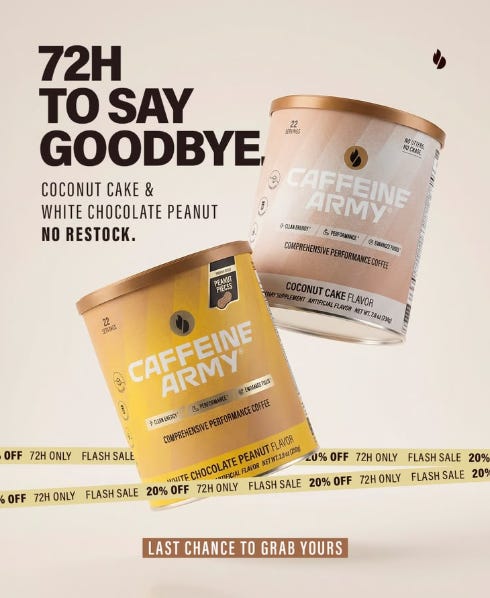
What Works:
Scarcity Leads Hard - “72H to say goodbye” and “no restock” create immediate urgency, making the flavors feel genuinely finite while giving procrastinating buyers a clear reason to act now.
Products Stay Central - The two oversized tubs dominate the composition, keeping product recognition high while the diagonal placement adds movement and stops the creative from feeling static.
Offer Reinforces Action - The repeated “20% off” flash-sale tape compounds urgency and discount recall, while the bottom CTA closes the loop with a direct last-chance purchase prompt.
Combine a deadline, no-restock message and visible discount in one frame. Repeating urgency from different angles can increase action without relying on a single headline alone.
🥳 Events
🔥 How to Make ChatGPT and Claude Work With Your CRM
November 5 | 11 AM ET | Virtual Event
See how HubSpot connects your preferred AI assistant to real customer context, so you can ask questions, update records, and act without bouncing between tools. You’ll also learn how HubSpot’s headless strategy and built-in governance let teams use AI with more context and control.
Can’t attend the session live? Register anyway, and you’ll get the recordings in 24 hours.
Advertise with Us
Wanna put out your message in front of over 50,000 best marketers and decision makers?
We are concerned about everything DTC and its winning strategies. If you liked what you read, why not join the 50k+ marketers from 13k+ DTC brands who have already subscribed? Just follow this.
At ScaleUP, we care about our readers and want to provide the best possible experience. That's why we always look for ways to improve our content and connect with our audience. If you'd like to stay in touch, be sure to follow us EVERYWHERE🥰
Thanks for your support :) We'll be back again with more such content 🥳