
Howdy Readers 🥰

In this newsletter, you’ll find:
⚠️ Publishing new content while old articles rot is a losing strategy
📊 YouTube Broke Out This Week, And the Rest of the Platform Map Shifted Around It
🏆 Ad of the Day
If you’re new to ScaleUP then a hearty welcome to you. You’ve reached the right place along with 50k+ CEOs, CMOS, and marketers. Let’s get into it, shall we? Oh! Before you forget, if someone forwarded this newsletter to you, don't forget to subscribe to our newsletter so you never miss out!
⚠️ Publishing new content while old articles rot is a losing strategy
Most content teams measure output by volume. Articles published per month, words produced per week, and topics covered per quarter. The number goes up and the strategy looks healthy.
But if your refresh rate is lower than your publishing rate, you’re building on a leaking foundation.
Here’s how to fix the ratio.
Why decaying content compounds faster than you think
Every article you published 18 months ago is sitting on a keyword where intent has shifted, competitors have updated their content, and your information may no longer be accurate.
Google’s quality signals account for freshness on competitive queries. An outdated article doesn’t just stop ranking, it actively pulls down the credibility signals on the pages around it.
Publishing five new articles a week into a catalog of 300 decaying ones doesn’t grow your authority. It dilutes it.
Build a refresh priority queue
Not every article needs updating at the same frequency. Sort your existing content into three tiers based on one metric: ranking position versus traffic potential.
Tier one: Articles ranking positions 4 to 15 on commercial or high-intent keywords. These have traction and a realistic path to page one with a targeted update. Refresh these every 90 days.
Tier two: Articles that ranked well historically but have dropped in the last six months. Pull Google Search Console impression data to confirm they’re still being served. Update these every 180 days.
Tier three: Informational content with stable, low-competition keywords and consistent traffic. These need a light accuracy pass once a year, nothing more.
What a proper refresh actually involves
A refresh is not adding two paragraphs and changing the publish date. That fools nobody, including Google.
A real refresh covers four things. First, update any statistics, claims, or references that have a date attached to them.
Second, restructure the article to match current search intent, check the top three ranking pages for the target keyword and align your format to what Google is currently rewarding.
Third, add or update internal links to reflect your current content architecture. Fourth, expand any section where a competitor is now outperforming you on depth or specificity.
Each of these changes signals a genuine content update, not cosmetic maintenance.
Set the right ratio
Planable’s 2026 Agency Profitability Report found that high-margin agencies optimize existing assets before scaling output. The same principle applies here.
A sustainable content operation refreshes at least one existing article for every two new ones published. If your catalog is large and your team is small, flip that ratio entirely until the backlog is clean. You can get the report for free
New content gets you into conversations. Refreshed content keeps you in them.
Audit the decay before adding to the pile.
📊 YouTube Broke Out This Week, And the Rest of the Platform Map Shifted Around It
Intro Last week’s paid media environment produced one of the cleaner divergence patterns in recent months, a single platform pulled sharply ahead on nearly every efficiency metric while costs and returns fragmented across the rest.
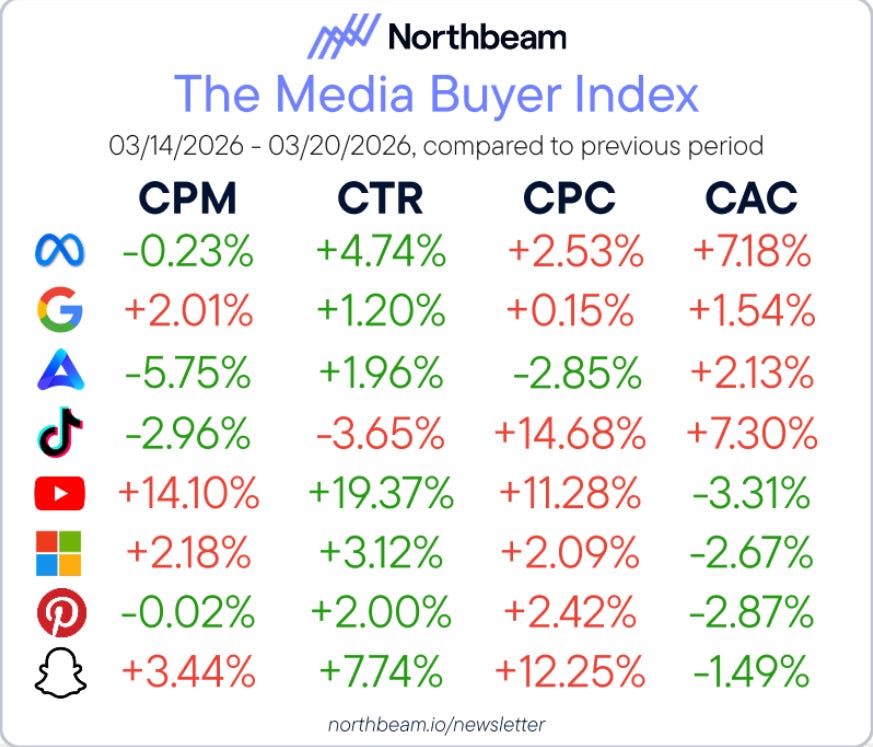
The Breakdown:
1. CPC - AppLovin and TikTok saw costs fall while TikTok, YouTube, and Snapchat pushed higher. If CPC is rising on your core channels, test into AppLovin, where costs dropped, and conversion rates improved simultaneously.
2. CAC - YouTube, Microsoft, Pinterest, and Snapchat all improved acquisition costs while Meta and TikTok worsened. When CAC rises despite healthy click volume, the fix is post-click, not media: audit landing pages, offer clarity, and checkout friction before touching bids.
3. ROAS - YouTube led at +15.17%, and AppLovin posted +8.59% while Microsoft (-3.68%) and Pinterest (-3.47%) slipped. YouTube’s ROAS breakout alongside a CTR surge of nearly 20% makes it the most validated scaling signal this week.
Meta regained share to 64.91% while Google shed 3.03% and AppLovin dropped 3.88% despite strong returns. YouTube at 2.60% budget share with +15.17% ROAS and growing engagement is being systematically underfunded, and that gap will get more expensive to close the longer allocation stays static.
🏆 Ad of the Day
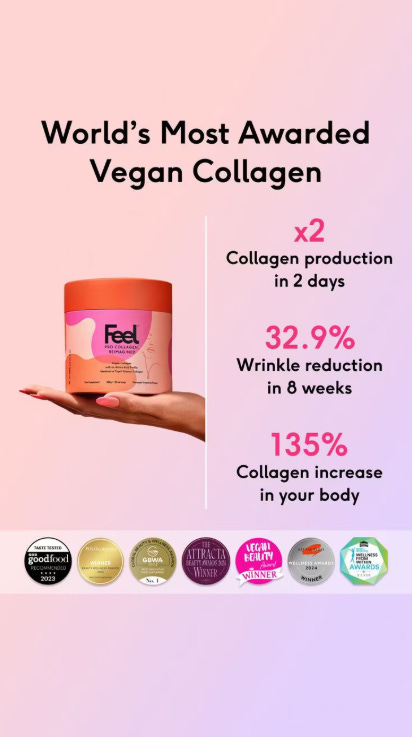
What Works:
The Hidden Conversion Mechanism
This ad wins by overwhelming doubt with stacked proof density. Instead of one claim, it floods the viewer with awards, percentages, and timelines, making skepticism feel irrational. You’re not evaluating, you’re conceding to volume.
The numbers aren’t meant to be verified; they’re meant to feel directionally undeniable, creating a sense of measurable transformation.
“Vegan collagen” also resolves a built-in contradiction, making the product feel like a category breakthrough.
Don’t argue that your product works. Stack so much structured proof that doubting it feels like overthinking.
Advertise with Us
Wanna put out your message in front of over 50,000 best marketers and decision makers?
We are concerned about everything DTC and its winning strategies. If you liked what you read, why not join the 50k+ marketers from 13k+ DTC brands who have already subscribed? Just follow this.
At ScaleUP, we care about our readers and want to provide the best possible experience. That's why we always look for ways to improve our content and connect with our audience. If you'd like to stay in touch, be sure to follow us EVERYWHERE🥰
Thanks for your support :) We'll be back again with more such content 🥳