
Howdy Readers 🥰

In this newsletter, you’ll find:
🫢Your Dashboard Is Taking Credit For Sales It Never Created
📱 Social Platforms Are Making Content Easier To Create
🏆 Ad of the Day
If you’re new to ScaleUP then a hearty welcome to you. You’ve reached the right place along with 50k+ CEOs, CMOS, and marketers. Let’s get into it, shall we? Oh! Before you forget, if someone forwarded this newsletter to you, don't forget to subscribe to our newsletter so you never miss out!
Together with AirOps
What 400+ Sites Reveal About Surviving Google’s AI Overviews

Everyone’s bracing for Google Zero. Cyrus Shepard studied 400+ sites and found the ones still growing share five specific traits.
Zero-click search is real. The “SEO is dead” takes are not the full story.
Cyrus mapped what’s actually driving organic growth right now, plus the 17 content types most likely to survive Google Zero.
On July 23rd, AirOps is hosting Cyrus for a practical session on what every content team is trying to decide: what to keep investing in, what to rethink, and where AI actually helps.
You’ll walk away with:
The five traits behind sites still growing in Google
Which content formats still earn their keep, and which are getting harder to justify
How to turn proprietary assets you already own into content
Where AI fits now: what to stop producing faster, what to build instead
This webinar is built for everyone, from SEO and content leaders to content directors and growth teams.
Can’t make it live? Register anyway and get the recording in your inbox within 24 hours.
🫢Your Dashboard Is Taking Credit For Sales It Never Created
All Meta accounts are optimizing for the wrong outcome.
Switch one campaign to incremental attribution and accept that the reported ROAS will probably fall. It sounds counterintuitive, but that decline is often the first sign the account is becoming more accurate, not less.
Here’s why.
Standard attribution rewards Meta whenever it touches a conversion, even if that customer was already going to buy. Someone had the product in their cart. Someone came back through email. Someone searched for the brand directly. The platform still claims credit.
The algorithm then learns a dangerous lesson.
Instead of finding people who need persuasion, it starts by finding people who were already on their way to purchasing. ROAS looks fantastic while very little incremental demand is actually being created.
Incremental attribution changes that incentive.
Rather than asking, “Did an ad touch this conversion?” it asks, “Would this conversion have happened without the ad?” Only conversions genuinely influenced by advertising receive credit.
That shift produces an uncomfortable pattern.
Reported ROAS often falls, sometimes by 30 to 40 percent, because inflated conversions disappear from the report. Yet many advertisers simultaneously see stronger blended revenue and faster new customer growth because spend is finally reaching people who actually require advertising to convert.
The business improves while the dashboard gets uglier.
That disconnect is exactly what makes adoption difficult.
Instead of rolling it out account-wide, treat it like an experiment.
Select one campaign with stable spend and clean conversion volume.
Run incremental attribution for four weeks without changing anything else.
Then ignore the number everyone usually watches.
Evaluate the test using business metrics instead: total new customers, blended revenue, and marketing efficiency ratio. If in-platform ROAS drops, that’s expected. The purpose of the test is to measure what the ads truly caused, not what they happened to touch.
Before launching, prepare one comparison slide.
Put old reported ROAS beside new customer growth over the same period. When one falls and the other rises, that single chart becomes the evidence stakeholders need to keep the experiment running.
The next generation of winning Meta accounts won’t belong to advertisers with the highest reported ROAS.
They’ll belong to advertisers measuring the customers their ads actually created.
📱 Social Platforms Are Making Content Easier To Create
The latest updates from Meta, YouTube, and TikTok all point in the same direction. Platforms are making it faster to publish, easier to engage, and less dependent on producing polished videos.

The Breakdown:
Meta Experiments With Play - Meta’s new Pocket app replaces a traditional feed with AI-generated, promptable mini games that respond to touch and movement, turning scrolling into a more interactive experience.
YouTube Expands Shorts - Creators can now publish image posts and photo carousels directly into the Shorts feed, complete with up to 15 seconds of music for lightweight visual storytelling.
TikTok Speaks More Languages - TikTok added bilingual captions with automatic translation into more than 14 languages, alongside richer templates, clip locking, and new seasonal audio effects for creators.
The next wave of creator tools isn’t about making bigger productions. It’s about removing friction, making content easier to publish, and giving creators more ways to engage audiences without starting from scratch every time.
🏆 Ad of the Day
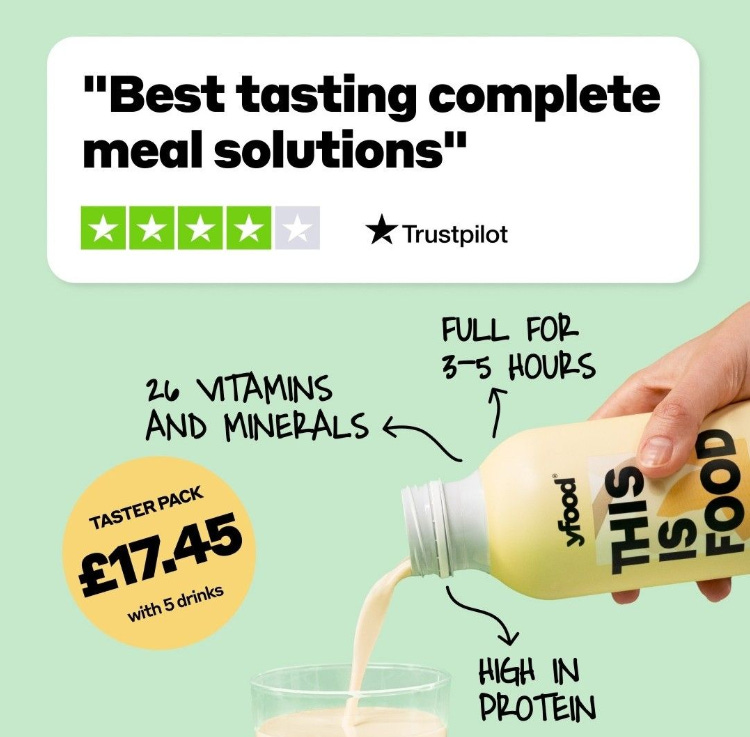
What Works:
Third-Party Validation - The Trustpilot rating appears before any product claims because independent reviews carry more credibility than brand messaging. Borrowing external trust reduces skepticism before customers evaluate the product itself.
Handwritten Guidance - The doodle-style annotations make nutritional benefits feel easy to understand instead of clinical. Friendly visual cues simplify complex information and increase the likelihood that people actually read it.
Value Before Price - The creative establishes taste, nutrition, and satiety before revealing the £17.45 offer. Demonstrating value first makes the price feel like a bargain instead of the focal point.
Lead with a trusted review platform, certification, or customer endorsement before presenting your product benefits. Third-party credibility lowers resistance and makes every following claim feel more believable.
Advertise with Us
Wanna put out your message in front of over 50,000 best marketers and decision makers?
We are concerned about everything DTC and its winning strategies. If you liked what you read, why not join the 50k+ marketers from 13k+ DTC brands who have already subscribed? Just follow this.
At ScaleUP, we care about our readers and want to provide the best possible experience. That's why we always look for ways to improve our content and connect with our audience. If you'd like to stay in touch, be sure to follow us EVERYWHERE🥰
Thanks for your support :) We'll be back again with more such content 🥳