
Howdy Readers 🥰
In this newsletter, you’ll find:
🧺 Two products, two very different baskets: why cart profit should set your Q4 bids
📉 Google Ads seasonality adjustments hurt black friday performance, study finds
🏆 Ad of the day
If you’re new to ScaleUP then a hearty welcome to you. You’ve reached the right place along with 50k+ CEOs, CMOS, and marketers. Let’s get into it, shall we? Oh! Before you forget, if someone forwarded this newsletter to you, don't forget to subscribe to our newsletter so you never miss out!
Together with Omnisend
Imagine beating a month’s email revenue with one send

You’d probably double-check the numbers.
Enflow Digital did exactly that for a skincare client ahead of BFCM. One plain-text email sent through Omnisend to 1,676 recipients generated nearly $18,000, beating the previous month’s broad-audience campaigns combined.
Omnisend helped the team find the right customers to send it to. Its segmentation and MCP capabilities let them uncover purchase patterns in minutes.
Co-founder Karolina shares how they pulled it off with Omnisend, from choosing the audience to making the offer worth opening. Worth a read (or a watch) before you hit send on your own BFCM campaigns.
New to Omnisend? It’s an email and SMS marketing platform for ecommerce used by more than 150,000 brands, generating an average of $79 for every $1 spent. Migration is free and takes up to five business days.
🧺 Two products, two very different baskets: why cart profit should set your Q4 bids
This week, Google’s Ads Liaison account pointed advertisers to a point many accounts ignore: basket profitability matters more than basket size, and cart data is how you see it. Search Engine Roundtable flagged the post in its October 19 recap.
Here’s what that looks like with two illustrative products.
The comparison
Product A: a $15 phone case. Its own margin is $6. Shoppers who click its ad often add a charger and a screen protector. Average gross profit per order: $42.
Product B: $120 headphones. Its own margin is $30. Shoppers usually buy the headphones alone. Average gross profit per order: $31.
On revenue-based ROAS, Product B looks like the obvious bid priority. On profit per order, Product A wins by $11, despite costing an eighth as much.
Standard Shopping reports show you Product B’s picture. Cart data shows you Product A’s.
What cart data adds
Conversions with cart data sends the items in each order, with product IDs, quantities and prices, from your purchase tag to Google Ads. Add cost of goods sold in your Merchant Center feed and the reports can show:
Lead items: the product whose ad was clicked
Cross-sell items: everything else in the basket
Gross profit: at item and order level, when costs match by product ID
Setup checklist
Make sure your purchase event sends every item with an ID matching your Merchant Center feed.
Include discounts, so profit reflects what buyers actually paid.
Add the cost_of_goods_sold attribute to your feed. Items without it are skipped, which understates profit.
Check coverage first. Before trusting the report, confirm what share of sold items carry a cost value.
Three Q4 decisions to make with it
Protect profitable leads. Products like the phone case deserve budget even with weak standalone ROAS. Group them separately so they aren’t starved by the bidding.
Question expensive heroes. High-price products that sell alone can look strong on revenue and still return less profit per order.
Price your doorbusters honestly. A Black Friday loss leader only works if the baskets behind it make up the loss. Check last November’s cart data for each planned doorbuster before cutting its price.
Compare gross profit per order by lead product every week through Cyber Monday. If a doorbuster’s baskets stop carrying cross-sells, pull its budget before the loss compounds.
Check whether your purchase event sends item IDs that match your feed. Without that match, none of this reporting works.
📉 Google Ads seasonality adjustments hurt black friday performance, study finds
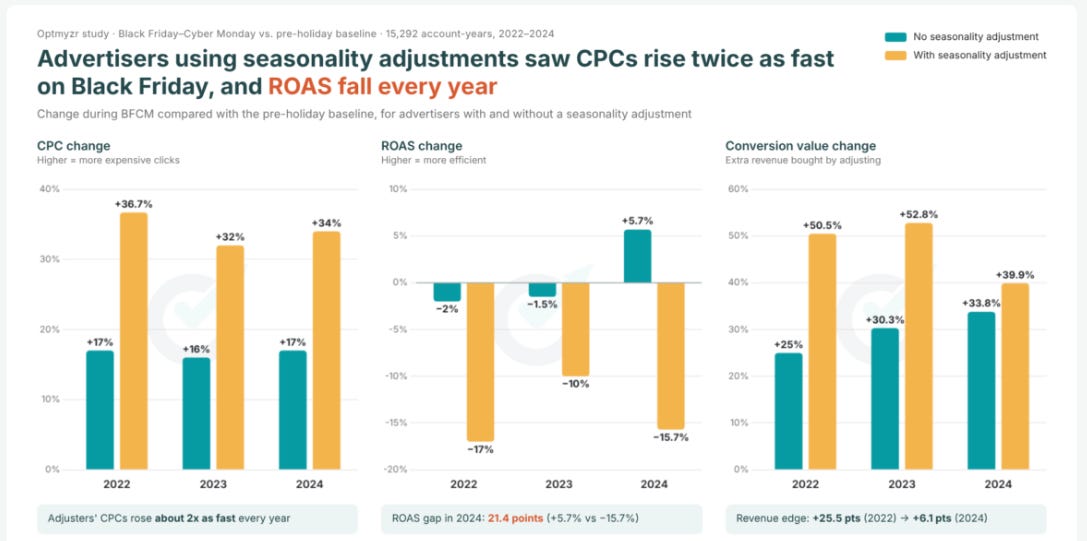
An analysis of 5,886 Google Ads accounts in 2024, supported by findings from 2022 and 2023, found that advertisers using seasonality adjustments during Black Friday and Cyber Monday experienced higher advertising costs and weaker returns.
The Breakdown:
Ad Costs Rose Twice as Fast - Advertisers using seasonality adjustments saw cost per click increase 34%, compared with a 17% rise among those relying on Google’s Smart Bidding without adjustments.
Return on Ad Spend Dropped 15.7% - Accounts using adjustments experienced a 15.7% decline in ROAS, while those without adjustments recorded a 5.7% increase, a difference of 21.4 percentage points.
Black Friday Conversion Gains Are Shrinking - Among accounts without adjustments, conversion rate increases fell from 17.5% in 2022 to 7.5% in 2024, suggesting shoppers are spreading purchases across longer promotional periods.
Budget Controls Offer an Alternative - The analysis recommends monitoring CPC increases, checking conversion tracking, and adjusting ROAS targets instead of overriding Smart Bidding. Seasonality adjustments may still help with unexpected, business-specific promotions.
The findings suggest that manually forecasting conversion spikes during Black Friday can lead to excessive bidding costs, especially when Google’s algorithms already anticipate seasonal demand. Advertisers may benefit more from accurate conversion data, flexible budgets, and performance monitoring.
🏆 Ad of the Day
What Works:
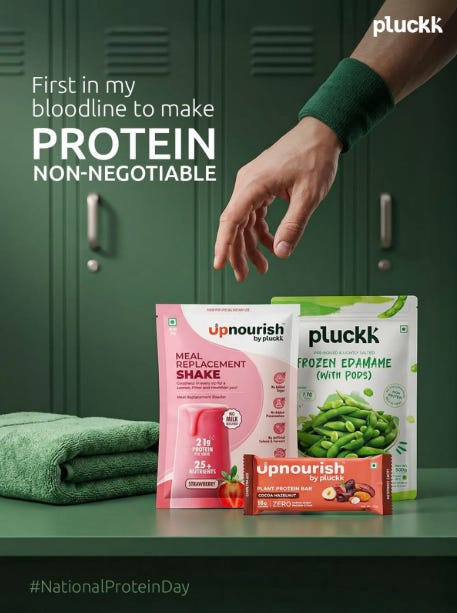
Gym Context Fits - The locker-room setting instantly anchors the products to fitness routines, strengthening message-market fit while the reaching hand creates movement and guides attention toward the lineup.
Identity Drives Commitment - “First in my bloodline to make protein non-negotiable” turns nutrition into an identity statement, making the behavior feel disciplined, aspirational and emotionally bigger than a product claim.
Range Signals Convenience - Showing shake mix, protein bar and edamame together communicates multiple ways to hit protein goals, reducing routine friction and making the brand feel more useful across the day.
Frame the behavior your product supports as part of who the customer is becoming. Identity-led copy can make functional categories feel more motivating and memorable.
🥳 Events
🔥 What Changes When Creator Programs Scale From 5 to 5,000
Today | Online | Free Festival
Return on Influence Festival ’26 opens up the systems behind large creator programs, including how teams track ROI, improve partnerships, and avoid operational chaos as volume grows. Hear directly from leaders at Adobe, ŌURA, Edelman, Ogilvy, and more.
Can’t attend every session live? Register anyway, and you’ll get the recordings in 24 hours.
🔥 Where to Put Your Next Growth Dollar Beyond Meta
October 29 | The Glasshouse, NYC | Free In-Person Event
Hear how Reddit CEO Steve Huffman thinks about discovery, how Cody Plofker helped scale Jones Road Beauty to nine figures, and how brands like Liquid I.V. and MANSCAPED use TV to drive measurable revenue. Bring your hardest acquisition question and leave with a sharper channel plan.
Advertise with Us
Wanna put out your message in front of over 50,000 best marketers and decision makers?
We are concerned about everything DTC and its winning strategies. If you liked what you read, why not join the 50k+ marketers from 13k+ DTC brands who have already subscribed? Just follow this.
At ScaleUP, we care about our readers and want to provide the best possible experience. That's why we always look for ways to improve our content and connect with our audience. If you'd like to stay in touch, be sure to follow us EVERYWHERE🥰
Thanks for your support :) We'll be back again with more such content 🥳